Thursday, October 6, 2011

Approaches for strengthening stakeholders abilities (23)


Post by Andrea Rudiger (FAO) and Chiara Ferri (FAO)
Photos by Michela Baratelli (FAO) and Chiarra Ferri (FAO)

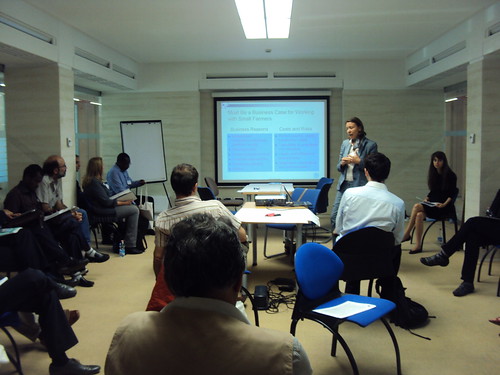
The FAO Research and Extension Branch has jointly presented three of its initiatives at the third day of the Global Share Fair under the title “Approaches for strengthening stakeholders’ abilities to generate, adapt and share experiences”.
Approaches for strengthening stakeholders abilities (23)

1. Food Security through Commercialization of Agriculture (FSCA/PISA)

“What I hear, I forget. What I see I remember. What I do, I know.”

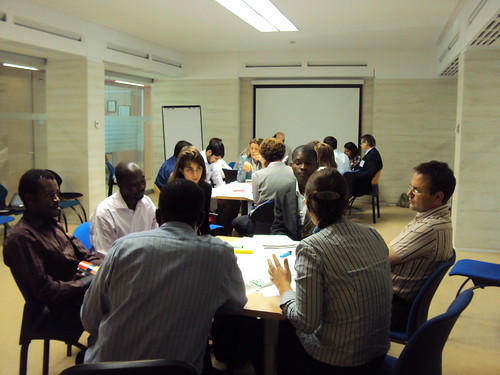
Participants from seven Western African countries, in which Food Security through Commercialization of Agriculture (FSCA/PISA) Projects are being implemented, met in Dakar in 2010. In a workshop participants learned ten new communication tools, such as SWOT analysis, open space, mind mapping, chat show and mapping of communication flows. They used them actively for knowledge exchange and learning from local solutions to challenges common to all FSCA/PISA initiatives. Even though the participants did not all share a common language, the interpretation as well as focussing on visual methods was very helpful in establishing exchange that continues beyond the workshop.

2. Applied Technologies and Practices for Small Agricultural Producers (TECA)
Approaches for strengthening stakeholders abilities (23)  
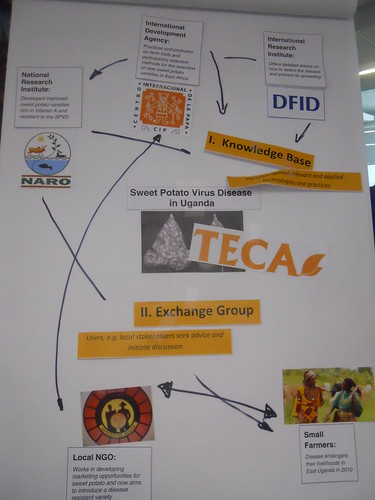
Using the example of a sweet potato disease outbreak in Eastern Uganda, the aims and functions FAO’s online platform for applied technologies and practices (TECA) were illustrated. Partners of TECA such as NARO (National Agricultural Research Organisation in Uganda), the International Potato Center (CIP) and DIFID have shared sweet potato technologies on TECAs online knowledge base. The manager of a local NGO, who has direct contact with local farmers, used TECA’s Exchange Group to alert other stakeholders to the problem and was put in touch with a CIP researcher. TECA enabled this NGO to respond more effectively to the problem on the ground.

3. Rural and Agricultural Development and Communication Network in Egypt (RADCON)
Approaches for strengthening stakeholders abilities (23) 

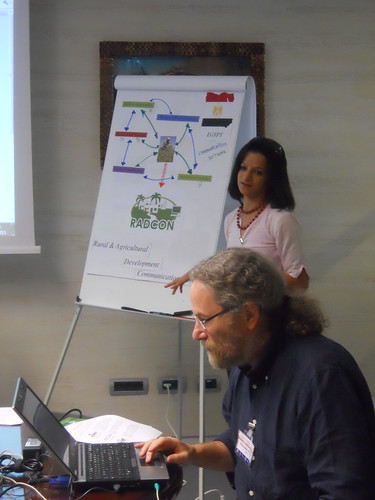
RADCON addresses the communication gap between research centres, extension services, the ministry of agriculture, the private sector and above all small farming communities with a special focus on women and youth. The network facilitates the sharing of knowledge among all stakeholders. At the core of the network are the RADCON centres, to which individual farmers can go to ask specific questions concerning their farming practices. These centres are linked to five so called expert systems (on rice, tomatoes, wheat, grapes and beans), to which village facilitators send the inquiries and receive feedback from specialists. Similar projects are being implemented for example in Bhutan, Uganda and Armenia as part of the Virtual Extension and Research Communication Network (VERCON).

All of these initiatives face challenges, which were discussed in some detail in the session.

To make these communication tools and systems work, building capacities for technology and empowering local actors is often necessary. In some cases this means to train basic computer skills (as in the case of VERCON Bhutan). In other cases a face-to-face interaction of an online community might be necessary, thus realising the human component of technology adoption.

Another challenge is to build sustainable solutions, which will endure when the external resources are no longer available. All three initiatives require commitment of human and financial resources by the partners, particularly governments. In the case of TECA the team at FAO can support partners (like research institutes or development agencies) by providing the software for a decentralised platform, but they will have to commit resources to its adaptation to their needs and its maintenance.

Wednesday, October 5, 2011

Build competitive business relationships between smallholder supplier groups and agribusinesses (7)

Post by Siobhan Kelly (FAO) and Denise Senmartin
Photos by Denise Senmartin.

The World Cafe session shared experiences from three cases pilot tested under FAO’s business model approach. Discussions at the coffee tables focussed on challenges that each of the pilot cases have been confronted with during implementation and as a result some strategic activities and ideas have been proposed that can be adopted during the last months of the projects. Some ideas proposed have been:

ShareFair2011 #7 

THE CASE OF RICE IN MALI
Should FAO encourage the Federation to get a new loan to be able to increase volume?

  • An upcoming feasibility study needs to focus on understanding if significant improvement in quality can make the business model profitable.

THE CASE OF CASSAVA IN ZAMBIA
To promote and strengthen the competitiveness of the industrial sector, should FAO and other projects work with commercial farmers in order to satisfy the procurement needs of the industrial buyers?
  • Engagement with commercial farmers should be accompanied by strengthen of district farmer associations in agribusiness skills and contract management to ensure equitable bargaining power.

THE CASE OF PISTACHIO IN IRAN
How can trust and collaboration be stimulated within a supply chain to improve overall competitiveness and introduce win-win solutions for all chain players?
  • Sharing technology and know-how which stimulates linkages vertically and horizontally in the chain.
  • Implementing rigorous quality control to improve buyers trust in the chain.
 
ShareFair2011 #7 

The World Café methodology allowed for a dynamic exchange for every participant to express their ideas. The word from some of the them?

“I enjoyed the approach of the World Café. Working for a NGO, I am interested in learning and capturing FAO´s experience as they can reach the policy levels. There is still work to do and the discussion, for example in the Cassava project, can help.” And then, at the stairs “It was my first session like this, I´m an intern at IFAD, so had not much ideas to provide yet but learnt a lot!”

Thanks for the meaningful, inspiring and energetic conversations, even though we forgot the candy!

Sunday, October 2, 2011

Mobile agri-business in Congo (133) - matchmaking challenges and promises

On Tuesday 27 September, Narcisse Mbunzama Lokwa
exposed his mobile agro-business enterprise. Mobile phones – and particularly short messenging services (SMS) - offer opportunities for farmers to develop their capacities, share information about their products and connect with markets in real time. This helps them increase their knowledge about the possibilities to sell their products, increase their productivity and their revenues. The overall objective is to develop food security and better health of the poor in rural Congo and other areas.

The 8 participants to the session questioned the business model of Narcisse, who pays for the service (the connecting service is free except for farmers that wish to sell their products in that way), the connectivity of farmers (who do have access to mobile phones in the areas where Narcisse is working) and the potential to scale it up to other, perhaps more deprived, areas (which seems to be a challenge at this stage). One of the participants suggested introducing positive competition among farmers by increasing the transparency of their offers, to stimulate better productivity and a more effective matchmaking.


The session was short but showed there is potential to expand this kind of mechanisms and to connect with similar initiatives in the region (Congo-Brazza, Cameroon etc.).