Showing posts with label knowledge management. Show all posts

Wednesday, August 24, 2011

What is cooking for the Second Global AgriKnowledge Share Fair #sfrome: 26-29 September 2011 at #IFAD HQ


When I interviewed Willem Bettink - one of the co-organizers of the Second Global AgriKnowledge Share Fair just before he left for his well deserved summer holidays, I could not imagine that we would all have an intense working holiday.

As it turns out, those of us on the road and those in the office, have been glued to our computers, Blackberries and emails. And we've done so with gusto and pleasure!

So, you are wondering what the share fair steering committee is up to? Well, apart from being glued to our electronic devices, the organizing committee composed of colleagues from Bioversity, CGIAR, CTA, FAO, IFAD,and WFP, is finalizing the share fair programme which promises to be an exciting four day event, taking place from 26-29 September 2011 at IFAD headquarters.


We love suspense, so you need to wait a bit more to get the full-fledged programme, but in the meantime just to whet your appetite here are some of the highlights of this unique event:

  • a number of prominent personalities will share their inspiring experiences and insights

  • colleagues from all over the world in over 150 sessions, will share their knowledge and wisdom on a variety of rural development and agriculture related topics such as: food security, climate change, environmental friendly innovations, emerging trends in use of ICTs, new technologies and innovative agricultural and farming practices, market access, water, livestock, knowledge sharing, networks and communities of practice

  • participants can benefit from numerous training sessions on knowledge sharing methods, social media tools, emerging trends and lessons learnt

  • stunning art for AIDS exhibit

  • lots and lots of social reporting - you will see knowledge sharing methods and social media tools put to practice.... We WALK the TALK!!

We'll be webcasting the plenary sessions and a team of social reporters will bring you live this four day event. We'll be using a number of social media channels, such as Twitter, Facebook, Blogs and more. Make sure you follow #sfrome.

And we hope to see you all in Rome. If you do not want to miss this event, please make sure you register. For now goodbye and good night. A presto as they say in Italian!


Monday, October 18, 2010

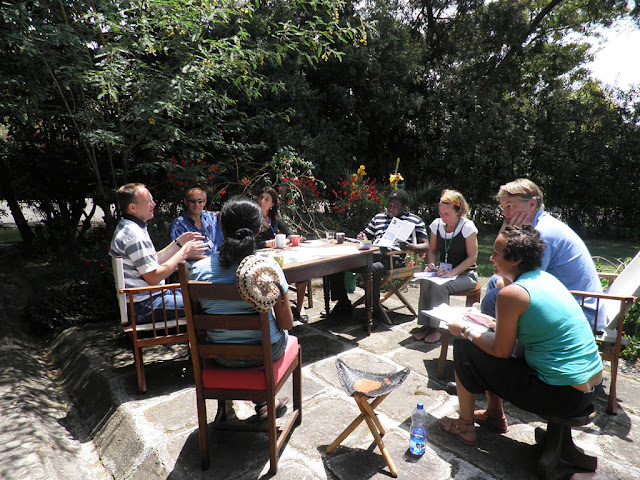
Day zero: "I know HOW day" starts at Agknowledge share fair #sfaddis

Originally posted on IFAD's social reporting blog


Our day started bright and earlier. At 9:00am sharp, the wonderful Ethiopian horn blower called us to order and we all gathered in the tent for Day Zero - or what was rebaptized as "The I know HOW day".

Before breaking out into parallel sessions, the participants identified language barrier and choice of appropriate tool and/or method as knowledge sharing challenges. The group also discussed how it would be unreasonable to expect a farmer who does not have access to the internet or cannot read or write fluently to use the internet as their primary source of information. We also talked about the challenge of technicians and researchers writing a 500 page highly technical report which hardly anyone would read. The participants recognized the fact that we need to prepare succinct and well written knowledge products which summarize and provide the salient points and findings!

The face-to-face session was facilitated by KM4Dev colleagues: Pete, Ewen, Gauri, Willem and Roxy. We started off with an icebreaker giving the over 30 participants to share something about themselves. Since we did not have a set agenda, to come up with an agenda, Pete and Ewen used open space to develop "an agenda".


Colleagues proposed a number of face-to-face knowledge sharing methods and by voting the group decided to learn more about peer assist - hosted by Willem, After Action Review - hosted by Edna, Story telling hosted by Roselin.

The participants then got organized and attended the various sessions. At the end of the session we did an After Action Review, which helped us to further fine tune the afternoon session.

As a result, we decided to use speed geeking as an icebreaker, rather than the ball in the room method. I must admit it was better!!! Especially because it was after lunch and the speed geeking also served as energizer!!!

If you've been following our tweets, you would have undoubtedly noticed that Ethiopian culture is one of the underlying principles of this event. So we not only have the horn blower who helps us to keep time, but also the Bunna corner - which is traditional Ethiopian coffee.


These wonderful ladies are around all day and ready to serve us coffee and to share their culture and history!! So knowledge sharing is not just about the highly tense technical documents, but also sharing the social and cultural aspects of what we know!!!! Never underestimate that.... That is where bonding happens and that is one of the many ways people will start trusting each other!!!

Now moving on to another session. More to come soon.

Sunday, October 17, 2010

Agknowledge Africa Share Fair: The show is on the road


It is months that we've been planning the Agknowledge Africa Share Fair - and now finally the show is on the road!!!

We're seeing the ILRI complex getting busier and busier by the hour. It is so nice to see old friends and colleagues. There is a nice feeling of anticipation about the event. Everyone is looking forward to meeting new people and to learn and share with each other.

The organizers met earlier today to go over the agenda and to iron out the last logistical issues before the big day. The social reporters will be meeting in less than 20 minutes to organize themselves. Make sure you follow us on the blog and on twitter. The hastag to follow is #sfaddis.

We're going to start tomorrow with what is now known as day zero. Day zero is a learning and sharing day, where a number of colleagues from various organizations will host different sessions on a range of topics such as:

  • blogging
  • collaborative writing
  • knowledge sharing methods
  • Google geo products
  • journalistic reporting

The big show starts on Tuesday and it promises to be an super EXCITING event. One of the great attractions of this event is the Ethiopian style market place, followed by the learning pathways - inspired by IFAD-funded PROCASUR programme. The learning pathways will focus on:
  • water
  • livestock
  • land
  • climate change
The event will also benefit from 5 thematic focus discussions on topics such as:
  • Young people
  • Documenting farmer knowledge
  • Writeshop process
  • Telecenters
  • Mobile devices
  • Storytelling
  • Make knowledge travel
  • Radio
  • Indigenous knowledge
  • Value chains
  • Reporting agriculture
  • Spoken web
  • KM impact assessment

So keep tuned on this channel. We'll be reporting live. If you have any queries, want to know more about the share fair please use this blog or twitter (#sfaddis) and share your thoughts with us!

Sunday, February 22, 2009

A month later: Reflecting on the lessons and feedback from the Share Fair

Only a month ago, during the Knowledge Share Fair, the FAO building and atrium was buzzing with energy and had become a learning and meeting hub for members of management and colleagues from Bioversity, CGIAR ICT-KM programme, FAO, IFAD and WPF.


For three days it was a common sight to see the organizing committee's members of management running into each other, engaging in formal and causal conversations. For three days it was a common sight to see colleagues having an opportunity to engage in casual conversation with members of senior management.


Only a month ago, the knowledge tree in the atrium was experiencing a wonderful spring as participants added leaves carrying their ideas, experiences, words of wisdom and inspiration.

Only a month ago the various meeting rooms at FAO saw meetings held in a different and innovative way and witnessed enthusiastic participants rushing from one session to another.

Only a month ago the e-learning lab and facilitation room witnessing a wonderful buzz as participants were telling each other about the new knowledge sharing tools, methods and techniques they had just learnt.

A month down the road, all of us feel more enriched. We now have bigger networks, new friends and new peers. The Share Fair has managed to demystify KM for lots of people. As a result, the various organizations are embracing and embedding KM methods, tools and techniques in their core processes. There is more awareness about the power and potential of Web2.0 tools as KM enablers which has led to more willingness to use these tools. The Share Fair has also helped create new networks and partnership between and among organizations.

The results of survey launched during the Share Fair shows that 67.3% of the respondents considered the Share Fair as a breath of fresh air, while 55% thought it was innovative. 66.5% of respondents rated the sessions as interesting, 52.2% said that they learnt something new, and 31% considered the various sessions as creative.

The hands-on sessions were a smashing success, followed by the booths and the technical sessions. The poster and video sessions were far from being successful.

The feedback also indicated that there were far too many sessions and a suggestion was put forward to repeat sessions. Another useful feedback came from our non-anglophone colleagues pointing out that they could not fully benefit from the various sessions because of language barrier. All of these are priceless feedback and will help make the next edition better.

Only a month ago we lived the energizing buzz of Share Fair. Together we learnt that is possible to bring about change, convert the KM cynics to KM practitioners. Now the challenge is to keep up the momentum and as Anatole France once said: "Man is so made that he can only find relaxation from one kind of labor by taking up another." So when are we going to start working on the 2010 edition of Knowledge Share Fair?

Friday, January 23, 2009

Session Report: Role of KM in Rural Development Projects

Session on Role of KM in Rural Development Projects, 23 January, 2009, 10.45 to noon at facilitation room
Comments by Cristina Sette

Session had four presenters, Emerson Ndovisai Zhou (IFAD - PAMA), Danilo Saavedra (FUNICA), Adrian Marbaniang (NERCORMP), and Kevin Gallagher (FAO).

Emerson (IFAD) presented a work he is involved in Africa, with market chain and support to farmers. The KS activities his project is currently carrying out are:
  • Disseminate what they were doing
  • Bring stakeholders together
  • Document lessons
  • Record what goes inside the project
  • Use consultants
  • Workshop
  • Printed documents (e.g. policy briefs)
  • Reflection
  • Disseminate what is working
  • Media (radio, video/tv) to bring awareness; publish stories (newspaper) at national and IFAD level
  • Training
  • Local workshops
  • Forums
  • Reach farmers
  • Platforms (national level) for discussions
Lesson: when to introduce the instruments of KM?
  • There isn't a KM department or a focus person for KM
  • Right KM tools
  • Involve stakeholders (local stakeholders)
  • Web as repository
  • Project implementation team (consultants)
  • One department taking the leadership
  • KM is important to improve project; feeding into M&E cycle

Danilo from FUNICA in Nicaragua presented a project related to food security in Nicaragua. He emphisized that the project had the incentives they had for KM were the following:
  • Resources/investments
  • Technological assistance
  • Improve the organization
The methodologies for KM were:
  • Farmer field school
  • Farmer to farmer (lead by National farmers organizations. They have their own methodologies)
Some of the lessons were:
  • Involve other institutions to support the project
  • Each institution look at KM to reduce poverty
  • Work with farmers

Adrian from NERCORMP in India presented a project they call "Systematization" which is a participatory tool for evaluate projects, which builda pool of knowledge and documents lessons learned. Website: www.enrap.org.in
The project phases are:
  • Preparatory
  • Grounding
  • Documentation (achieved through field visits, reporting, and post documentation)
The project activities are:
  • Identify areas/topics
  • Facilitators for each topic
  • Team assigned to an area
  • Team plan activities and present for feedback
  • Field visits by the team where they interact with the community
  • Reporting/documenting (it is a challenge)
  • Look at all resources (other types of reports)
  • Present
  • Pos documentation
  • Policy briefs

Some of the lessons were:
  • Participatory tool. Community evaluate themselves
  • Disseminate to other project areas
  • Identify topic must be done carefully
  • Sometimes we sounded too vague and we were not sure what to do
  • Make people write is difficult
  • Timing must be planed carefully
  • Having a KM specialist is good
  • Communication must be linked with M&E
  • The topics are chosen at district level
  • We asked ourselves if after the project if has been any changes
  • Doing this exercise requires time and funds

Kevin from FAO presented his work with farmer field schools in Sierra Leone.
The project consisted of introducing different methods with the FFS approach, build confidence/groups, and transfer knowledge.
Kevin's expereince with KM were as following:
  • Farmers own the knowledge
  • Farmers build business schools (agricultural business center)
  • Takes time to develop the processes and to build confidence
  • Focus on integrated pest management
  • FFS is a group of people who meet in the field
  • Farmers facilitate the procecss
  • Experts can present
  • Self organized
  • Cost
  • Radio
  • Up taking low in some countries (no promotion at international level, e.g. FAO and World Bank)
  • Info available but documentation expensive

Thursday, January 22, 2009

Session Report: Demystifying Knowledge Management: The Naked Truth

Session on Demystifying Knowledge Management: The Naked Truth (facilitated by Geoff Parcell), 22 January, 2009, 9.00 to 10.15 at Iran Room.

Comments by Cristina Sette

In this session we learned the process of self assessment on knowledge management. The session had a great attendance with the room almost full. After Geoff presenting a matrix with the levels of assessment and a sample of topics to be assessed, such as KM strategy, leadership behavior, networking, etc), the participants divided themselves into groups, according to their organizations. Those without colleagues from the same organization formed a group as well. Self assessment table presented below:


After 30 minutes of group discussion, Geoff asked us to place our organization within the ranking of levels given, 1 to 5, indicating where staff felt they are. Additionally, Geoff asked us to indicate which level we would like to be, as an organization.
He, then, demonstrated where each organization is on the river diagram. Based on where each topic appears on the diagram, they can seek improvements with the existing knowledge within the organization (as appeared in the self assessment) or, it the topic falls 'outside the water', it is likely that the organization needs external consultants to help them improve the topic. More on self assessment is at Geoff's book 'Learning to Fly'.
According to participants, the exercise was very useful and they had an overview of the process of self assessment.
Geoff commented that this self assessment also help individuals to learn from each other and how their perceptions from KM within their organizations may change after hearing the experiences of other colleagues.

Session Report: Leveraging Geographically Distributed Expertise through KS

Session on Leveraging Geographically Distributed Expertise through KS, 22 January, 2009, 10.45 to noon at Gabon Room.

Comments by Cristina Sette

The session was presented by German Escobar (IFAD - RIMISP), Tawfiq El-Zabri (IFAD - IDRC), Chase Palmeri (IFAD) and Huyen Tran (FAO).

German presented a network in Latin America which is currently in its 4th phase. The network involves the public and private sector, promotes learning and innovation, search results for problems and policy application, and value information. There is a part-time coordinator and am assistant involved in coordinating the network. The activities related to knowledge sharing and knowledge management happening at this project are the following:
  • KM analysis at National level
  • Bulletin (‘hosted’ independent from IFAD website)
  • Electronic conferences (designed with farmers and developing programs, 1-3 years)
  • Website library
  • Communication Tools (evaluate each method/tools every 3 years; qualitative indicators).
  • Field work to capture information
  • Training facilitators

Chase presented the activities she is involved in Asia and the Pacific. The KS activities going on depend highly on connectivity and the commonalities between the several projects and are as following:
  • Website
  • Email
  • Disseminate Info
  • Face to Face
  • Open to all members to participate
She mentioned the language constraints and the need to improve the network.

Huyen presented the global forum on food security which was created in October 2007. The forum is open to any user and has daily facilitated discussions (with invited subject matter specialists). It serves as a repository of information and also a way of involve people.
Some of the constraints are as following:
  • connectivity
  • involve more people (including FAO staff)
  • improve the visibility of the forum
Asked about the quality control of the information posted, the group mentioned that the moderator of the forum does the quality control, who also summarizes the discussion and translates into Spanish and French. Two full time staff are involved in moderating the forum. Recent evaluation showed that the forum is considered very useful

Tawfig presented the network called Karianet and his experience on building a regional network. The motivation of people to participate in the network are related to learning and improving performance.The way the network works focus on processes, practionaires, documenting knowledge and working with pilot projects. The lessons:
  • sustainability of the network:ownership, interest, symbolic membership fees, validate, involve private sector and rural communities.
  • in 2004 a needs assessment was carried(ownership) together with activities on capacity building targetting project managers to help them reflect. The process was supported by a knowledge facilitator and activities were carried out face to face to build trust and confidence. Participants learned about their own projects, beginning a change in culture.
  • The network concentrates on themes (e.g. M&E)
  • Documents (Reports)- K products
  • Demand driven
  • Sustainability after end project:
  • Topic relevant (views on it, stakeholders, share experiences)
  • Thematic and Regional Network