Showing posts with label sharefair09. Show all posts

Sunday, February 22, 2009

A month later: Reflecting on the lessons and feedback from the Share Fair

Only a month ago, during the Knowledge Share Fair, the FAO building and atrium was buzzing with energy and had become a learning and meeting hub for members of management and colleagues from Bioversity, CGIAR ICT-KM programme, FAO, IFAD and WPF.


For three days it was a common sight to see the organizing committee's members of management running into each other, engaging in formal and causal conversations. For three days it was a common sight to see colleagues having an opportunity to engage in casual conversation with members of senior management.


Only a month ago, the knowledge tree in the atrium was experiencing a wonderful spring as participants added leaves carrying their ideas, experiences, words of wisdom and inspiration.

Only a month ago the various meeting rooms at FAO saw meetings held in a different and innovative way and witnessed enthusiastic participants rushing from one session to another.

Only a month ago the e-learning lab and facilitation room witnessing a wonderful buzz as participants were telling each other about the new knowledge sharing tools, methods and techniques they had just learnt.

A month down the road, all of us feel more enriched. We now have bigger networks, new friends and new peers. The Share Fair has managed to demystify KM for lots of people. As a result, the various organizations are embracing and embedding KM methods, tools and techniques in their core processes. There is more awareness about the power and potential of Web2.0 tools as KM enablers which has led to more willingness to use these tools. The Share Fair has also helped create new networks and partnership between and among organizations.

The results of survey launched during the Share Fair shows that 67.3% of the respondents considered the Share Fair as a breath of fresh air, while 55% thought it was innovative. 66.5% of respondents rated the sessions as interesting, 52.2% said that they learnt something new, and 31% considered the various sessions as creative.

The hands-on sessions were a smashing success, followed by the booths and the technical sessions. The poster and video sessions were far from being successful.

The feedback also indicated that there were far too many sessions and a suggestion was put forward to repeat sessions. Another useful feedback came from our non-anglophone colleagues pointing out that they could not fully benefit from the various sessions because of language barrier. All of these are priceless feedback and will help make the next edition better.

Only a month ago we lived the energizing buzz of Share Fair. Together we learnt that is possible to bring about change, convert the KM cynics to KM practitioners. Now the challenge is to keep up the momentum and as Anatole France once said: "Man is so made that he can only find relaxation from one kind of labor by taking up another." So when are we going to start working on the 2010 edition of Knowledge Share Fair?

Wednesday, February 11, 2009

A Tree at the Share Fair


The tree is an all-encompassing symbol of creation, knowledge, life, inter-connectedness, wisdom... and most assuredly, one of sharing across cultures. In Africa, in particular, stories are exchanged around a baobab tree, whose trunk is often remarkably reminiscent of human shapes, intertwined and suggesting communication from the roots lying under the soil and the branches above. The tree represents a transformation of what lies unseen and unformed in the dark into concrete outputs represented by its leaves and flowers – ultimately food (e.g. fruit), shelter (e.g. umbrage) and natural energy (e.g. timber). Its seeds are scattered by the wind.

And so the Fair had its tree... born from the hands of Nancy White. A
tree with bare branches in need of leaves... thoughts... inspiration. A tree in winter, which was able to make passers by stop, and fill it with leaves. A strange process was enacted: the more someone would clothe the tree, the more they would expose their own ideas, revealing their feelings and attitude towards sharing. Leaf after leaf.


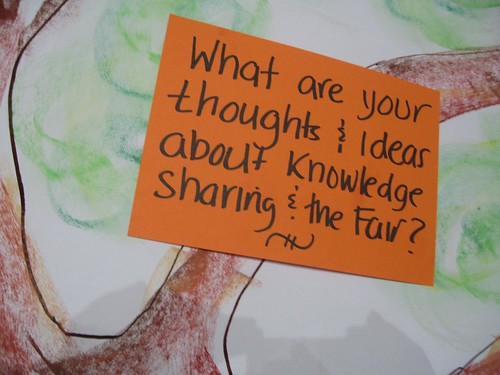
During the three days of the Fair, everyone passing by the Tree would either stop to read what others had written or, wrote something on the spot, as inspired by the question appended to its foliage: What are your thoughts and ideas about knowledge sharing and the Fair?


Following the outline of the tree leaves, one could find that barriers no longer were there, as an entirely new geography had been designed. One where Asian wisdom (“Of all one’s riches, wisdom is the best gift” – in Hindi) lay close to European poetry (“Do you know the land, where lemon trees grow?”- in German). For sure, one would see that "knowledge is not power..... sharing is!" And so, let us cultivate ways to nurture this spirit of sharing. How? For instance, strengthening the contents of what we share (interview to Margaret Zito, FAO Library). Talking about what we can do (Patrizia Cocca, Global Environment Facility). Bringing back home new beginnings and projects, as arising form the contacts we’ve made at the Fair (Paul Quek, Bioversity International). Mindful that sharing challenges our beliefs, the silo we are confined in and the barriers we have grown fond of. Ultimately, sharing requires daring, for “only creative people can work for sharing” as Ryszard Kozlowski, Editor of the Journal of Natural Fibers, has stressed – in Polish and English.


The tree also benefited from the insights received from the Going Green Group based at FAO. Instead of keeping their initiatives and tips confined to their stall, members of GGG brought spring to the tree, adding a lot of thoughts on how to respect the environment – directly on the tree branches. Many thanks to GGG for sharing directly on the tree!


Further to all this, the tree did one other thing – silently, gently, the tree transformed the Atrium into a garden, into the garden of sharing. And what is a garden?

A garden is a room populated with trees and plants. For some, it is a room to be shared with friends or relatives, a room which can be visited and where time is spent. Many things occur in a garden - the changing of seasons, the aging of trees, the withering of leaves from green into yellow, the blossoming of buds on barren branches, shadow and light… anything happening resumes images from our life.

The experience of the garden is one of true sharing among living beings, between nature and man. So much so that zen practitioners can see gardens buzzing with activity and life even in barren surroundings. More correctly: as springing from barren rocks and sand. How can they do it? Is that why some are talking about the zen of knowledge sharing?

The tree is currently hosted in the FAO Library.

Friday, January 23, 2009

Session Report: Role of KM in Rural Development Projects

Session on Role of KM in Rural Development Projects, 23 January, 2009, 10.45 to noon at facilitation room
Comments by Cristina Sette

Session had four presenters, Emerson Ndovisai Zhou (IFAD - PAMA), Danilo Saavedra (FUNICA), Adrian Marbaniang (NERCORMP), and Kevin Gallagher (FAO).

Emerson (IFAD) presented a work he is involved in Africa, with market chain and support to farmers. The KS activities his project is currently carrying out are:
  • Disseminate what they were doing
  • Bring stakeholders together
  • Document lessons
  • Record what goes inside the project
  • Use consultants
  • Workshop
  • Printed documents (e.g. policy briefs)
  • Reflection
  • Disseminate what is working
  • Media (radio, video/tv) to bring awareness; publish stories (newspaper) at national and IFAD level
  • Training
  • Local workshops
  • Forums
  • Reach farmers
  • Platforms (national level) for discussions
Lesson: when to introduce the instruments of KM?
  • There isn't a KM department or a focus person for KM
  • Right KM tools
  • Involve stakeholders (local stakeholders)
  • Web as repository
  • Project implementation team (consultants)
  • One department taking the leadership
  • KM is important to improve project; feeding into M&E cycle

Danilo from FUNICA in Nicaragua presented a project related to food security in Nicaragua. He emphisized that the project had the incentives they had for KM were the following:
  • Resources/investments
  • Technological assistance
  • Improve the organization
The methodologies for KM were:
  • Farmer field school
  • Farmer to farmer (lead by National farmers organizations. They have their own methodologies)
Some of the lessons were:
  • Involve other institutions to support the project
  • Each institution look at KM to reduce poverty
  • Work with farmers

Adrian from NERCORMP in India presented a project they call "Systematization" which is a participatory tool for evaluate projects, which builda pool of knowledge and documents lessons learned. Website: www.enrap.org.in
The project phases are:
  • Preparatory
  • Grounding
  • Documentation (achieved through field visits, reporting, and post documentation)
The project activities are:
  • Identify areas/topics
  • Facilitators for each topic
  • Team assigned to an area
  • Team plan activities and present for feedback
  • Field visits by the team where they interact with the community
  • Reporting/documenting (it is a challenge)
  • Look at all resources (other types of reports)
  • Present
  • Pos documentation
  • Policy briefs

Some of the lessons were:
  • Participatory tool. Community evaluate themselves
  • Disseminate to other project areas
  • Identify topic must be done carefully
  • Sometimes we sounded too vague and we were not sure what to do
  • Make people write is difficult
  • Timing must be planed carefully
  • Having a KM specialist is good
  • Communication must be linked with M&E
  • The topics are chosen at district level
  • We asked ourselves if after the project if has been any changes
  • Doing this exercise requires time and funds

Kevin from FAO presented his work with farmer field schools in Sierra Leone.
The project consisted of introducing different methods with the FFS approach, build confidence/groups, and transfer knowledge.
Kevin's expereince with KM were as following:
  • Farmers own the knowledge
  • Farmers build business schools (agricultural business center)
  • Takes time to develop the processes and to build confidence
  • Focus on integrated pest management
  • FFS is a group of people who meet in the field
  • Farmers facilitate the procecss
  • Experts can present
  • Self organized
  • Cost
  • Radio
  • Up taking low in some countries (no promotion at international level, e.g. FAO and World Bank)
  • Info available but documentation expensive

Session Report: Making Networks Work Within Institutions

Session on Making Networks Work Within Institutions, 23 January, 2009, 9.00 to 10.15 at Queen Juliana Room.
Comments by Cristina Sette

After three presentations (The Bluebar Group, FAO; IFAD Communities of Practice; Informal Commercialization and Agri-Business Interest Group, CABIG), a member of the audience asked presenters how senior management sees these initiatives, according to their perception.
Bluebar thinks that the informality is the success of this initiative. They don't need to interact with senior management for meeting once a month to interact and learn from each other. But they do need a facilitator to bring people together and carry on the interactions. IFAD is also informal but the group has a terms of reference. It is an output oriented group and their resources are very limited as they have no funds to cover costs with face to face interactions and no time for meeting. The CABIG group is also informal group.

The difference between the Bluebar group and the others is that the first is a network related to common interests and functions individuals perform in their units/departments. The others are related to a theme. Those groups are moving from an informal interaction to a formal network, however they have no funds to operate, using funds from other projects or sources.

Let's build on the Share Fair energy and momentum to bring about change

Seven hours ago the Share Fair came to end. As of 5pm today we have approximately 700 people more colleagues who have a better understanding of knowledge sharing and see the value-added of knowledge sharing. 700 people established new contacts and networks. 700 people learnt something new and shared something with others. And most importantly 700 people had fun.

I commend my colleagues for having proactively participated in great numbers. I commend my leadership who despite their busy schedules set aside at least half a day to come over to the Share Fair to visit the booths, talk to people and see for themselves the organization's knowledge in action. I commend senior colleagues and directors, who over the last three days visited the Share Fair more than once and spent considerable amount of time going to sessions and learning something new. I commend all my colleagues who spent many hours attending sessions and taking an active part in the Share Fair.

Kudos to all members of senior management, the Executive Director of our Change and Reform programme, our directors of HR, IT, policy, communications, technical advisory division, chief of staff and regional divisions directors.

Thanks to the Share Fair, we've increased the number of KM champions within the IFAD and converted some cynics. We've strengthened our partnership with the other agencies and built new networks, made new contacts and new friends.

Three days ago in my blog I said: "The fair's inauguration coincides with President-elect Obama taking oath of office. While history is being made across the Atlantic, in Rome, we too are taking an important step to bring about change by demystifying knowledge management and showing that KM is not a fad but a fact and a way of living." And YES we did it!!

We should all go proud of our achievement. The challenge is to keep the momentum and build on the positive energy. The closing ceremony may have closed the Share Fair but the real work starts now. And we are in a better position to do it, because thanks to our expanded networks we have more opportunities to draw on each other's knowledge.

Thursday, January 22, 2009

Session Report: Demystifying Knowledge Management: The Naked Truth

Session on Demystifying Knowledge Management: The Naked Truth (facilitated by Geoff Parcell), 22 January, 2009, 9.00 to 10.15 at Iran Room.

Comments by Cristina Sette

In this session we learned the process of self assessment on knowledge management. The session had a great attendance with the room almost full. After Geoff presenting a matrix with the levels of assessment and a sample of topics to be assessed, such as KM strategy, leadership behavior, networking, etc), the participants divided themselves into groups, according to their organizations. Those without colleagues from the same organization formed a group as well. Self assessment table presented below:


After 30 minutes of group discussion, Geoff asked us to place our organization within the ranking of levels given, 1 to 5, indicating where staff felt they are. Additionally, Geoff asked us to indicate which level we would like to be, as an organization.
He, then, demonstrated where each organization is on the river diagram. Based on where each topic appears on the diagram, they can seek improvements with the existing knowledge within the organization (as appeared in the self assessment) or, it the topic falls 'outside the water', it is likely that the organization needs external consultants to help them improve the topic. More on self assessment is at Geoff's book 'Learning to Fly'.
According to participants, the exercise was very useful and they had an overview of the process of self assessment.
Geoff commented that this self assessment also help individuals to learn from each other and how their perceptions from KM within their organizations may change after hearing the experiences of other colleagues.

Session Report: Leveraging Geographically Distributed Expertise through KS

Session on Leveraging Geographically Distributed Expertise through KS, 22 January, 2009, 10.45 to noon at Gabon Room.

Comments by Cristina Sette

The session was presented by German Escobar (IFAD - RIMISP), Tawfiq El-Zabri (IFAD - IDRC), Chase Palmeri (IFAD) and Huyen Tran (FAO).

German presented a network in Latin America which is currently in its 4th phase. The network involves the public and private sector, promotes learning and innovation, search results for problems and policy application, and value information. There is a part-time coordinator and am assistant involved in coordinating the network. The activities related to knowledge sharing and knowledge management happening at this project are the following:
  • KM analysis at National level
  • Bulletin (‘hosted’ independent from IFAD website)
  • Electronic conferences (designed with farmers and developing programs, 1-3 years)
  • Website library
  • Communication Tools (evaluate each method/tools every 3 years; qualitative indicators).
  • Field work to capture information
  • Training facilitators

Chase presented the activities she is involved in Asia and the Pacific. The KS activities going on depend highly on connectivity and the commonalities between the several projects and are as following:
  • Website
  • Email
  • Disseminate Info
  • Face to Face
  • Open to all members to participate
She mentioned the language constraints and the need to improve the network.

Huyen presented the global forum on food security which was created in October 2007. The forum is open to any user and has daily facilitated discussions (with invited subject matter specialists). It serves as a repository of information and also a way of involve people.
Some of the constraints are as following:
  • connectivity
  • involve more people (including FAO staff)
  • improve the visibility of the forum
Asked about the quality control of the information posted, the group mentioned that the moderator of the forum does the quality control, who also summarizes the discussion and translates into Spanish and French. Two full time staff are involved in moderating the forum. Recent evaluation showed that the forum is considered very useful

Tawfig presented the network called Karianet and his experience on building a regional network. The motivation of people to participate in the network are related to learning and improving performance.The way the network works focus on processes, practionaires, documenting knowledge and working with pilot projects. The lessons:
  • sustainability of the network:ownership, interest, symbolic membership fees, validate, involve private sector and rural communities.
  • in 2004 a needs assessment was carried(ownership) together with activities on capacity building targetting project managers to help them reflect. The process was supported by a knowledge facilitator and activities were carried out face to face to build trust and confidence. Participants learned about their own projects, beginning a change in culture.
  • The network concentrates on themes (e.g. M&E)
  • Documents (Reports)- K products
  • Demand driven
  • Sustainability after end project:
  • Topic relevant (views on it, stakeholders, share experiences)
  • Thematic and Regional Network

Wednesday, January 21, 2009

Session Report: Keeping Institutional Memory - Part 1

This session really made me think on two fronts: first, about the methodology used (the fishbowl. See a brief description on the kstoolkit site); and second about trying to approach institutional memory systematically.

The content: we started talking about several initiatives, including a collaboration platform for Human Resources staff, an online country brief intranet platform, and a manual for designing and implementing projects (see: I1004a, F1070 and X1030).

They, and other initiatives that came up, were quite different from each other in various ways (technologies, users, institutional contexts, etc.), but the conversation began to converge on some of the most difficult nuts to crack: how to generate enthusiasm and understanding of potential and actual benefits, how to ensure the content providers you depend on actually provide the content, how to ensure those who do share feel they are appreciated, etc.

I may be wrong, but I felt a real coming together among many participants around these issues and I certainly had a deeper appreciation not only of their importance, but more crucially of the importance of consciously integrating these issues into the design and implementation of knowledge sharing initiatives (in a project context, institutional context, network context, whatever).

We also talked about the fishbowl methodology itself: having a conversation within a group of about 25 people can be difficult, but a fishbowl can keep it manageable so only a few people talk at once, but everyone gets a chance to provide input if they want to. It also helps to get you physically out of the people around a u-shaped table scenario into one that is much more informal and relaxed, and where the energy is focused on the people as they face each other. It reinforces my belief in getting rid of tables as much as possible, and in the power of physical layout to promote interaction and participation. All in all, it was time well-spent :-)

Session Report: Knowledge Sharing and Good Water Governance

Session Report: Knowledge Sharing on Good Water Governance
Room: Facilitation Room
Time: 21 January 2009, 15:30 - 16:45


When I reviewed the submissions for the last panel I was facilitating today (Knowledge Sharing Methods on Good Water Governance), I was struggling to imagine the "hook" for the conversation across the projects. There is this interesting tension in many of the sessions, which is how much focus should we put on the domain/content (in this case governance in water issues) and how much on the theme of the fair, knowledge sharing? Because we all value the practical application of KS, this balance is important. We want to increase our KS skills, but not in some theoretical vacuum. So the hook between the content and the KS issues is important to me.

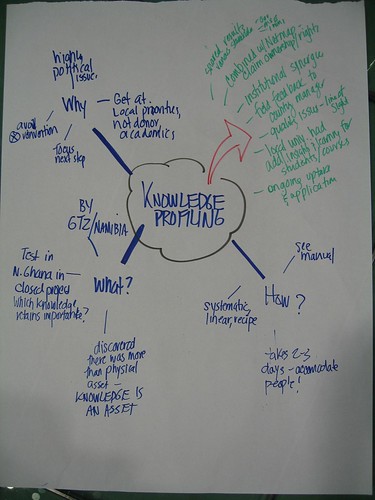
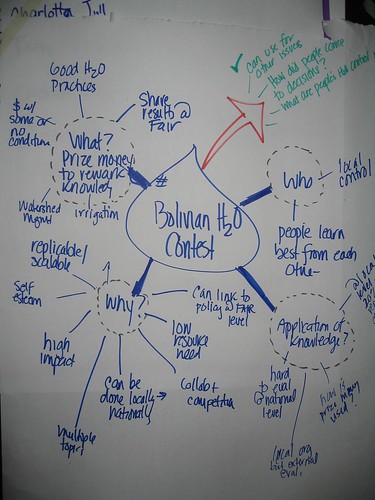
Well once Moses started talking about the application of Net Mapping to a dam project in Northern Ghana, the use of Knowledge Profiling in identifying knowledge as a product of a project and Frank shared the application of contests in a water governance initiative in Bolivia, I had a little aha. It should have been obvious, but sometimes we need to hear stories of use to see the light.

This was a really useful case of seeing various methods as not just the methods themselves, but as knowledge sharing methods. Why is this important? I think when we look at our work with a KS "lens" we see some different things. For example, in the NetMapping story of Ghana, Moses stated they used it initially at the close of a project as more of a post evaluation method. But as they used and deepened their knowledge of the method application, they saw that not only did they gain social network analysis data, but they observed how the method influenced the communication in the work, and how people begin to see new possibilities through this very visual method. Moses noted that they now see the method as something they can use at any phase of a project and that while it requires trust, it also generates some deeper communication. So this very act of knowledge sharing, as I understood it, changed the dynamics of the work.

We had less detailed information about the profiling method from Rudolph. My sense it was a more structured and detailed process, but again, it helps the participants "see" the learning in a different way. And thus share it in a different way. They noted that the Knowledge Profile results were useful in an academic setting and more formal evaluation. While the NetMap addressed the social and power aspects of the work.

Finally, Frank observed that using contests was both a well documented method useful in many contexts and domains, but a real insight for me was his suggestion that it is a good starter method to uncover knowledge that can be more formally assessed with the Knowledge Profile and to help guide the design of work.

How do we pick these methods? What is a good mix or sequence? Does the selection vary widely by context or are there some useful use practices we can uncover?

We can't know this unless we continue to swap stories as we did this afternoon. So for me the hook is to add a layer of learning while doing about methods and process, then share that learning outside and across our work to see if we can surface the range of methods and their applications for knowledge sharing in agriculture and food security.

Session Report: Leveraging Connections Among Networks by Nadejda Loumbeva


Leveraging Connections Among Networks
Facilitator - Nadejda Loumbeva
Day 2 at 13.45 in Espace Gabon


Process:
15 people (excluding the facilitator) participated in the session. 3 of those were presenters. We started off with describing the initiatives (ESCORENA network, e-Agriculture network, IMAWESA network). Then we moved onto a discussion. In the process of this, we used some of the computer and projector to show the websites of the featured networks.

Challenges to the process were:


  • All three initiatives were incredibly complex and we had to struggle with ensuring these are being shared concisely and ''to-the-point'', in ways that encourage people to see linkages among them and discuss.
  • Some of the presenters were taking a long time giving the background to their initiative. I had to work with them so that they focus more on the mechanisms underlying the network. It was a question of reinforcing them whenever they talked about mechanisms and gently stopping them when they would give away details that were (in my opinion!) distracting the discussion.
  • The Espace Gabon room is difficult in terms of 1. having a few flip chart sheets written on at one and the same time (there is no where to put them but stick them to one of the walls) and 2. having all people see those sheets (all would sit in an oval around a big table and so some people would always have their backs on them). This was making difficult the synergy between notes I would take on these sheets (one for each network and a fourth one for challenges and lessons learnt) and the actual discussion. I guess it would have been good to enable the session in a way that is more holistic (i.e., people seeing all notes, and making connections among them whilst participating) however I do not think this worked.

Summary of some of the discussion:

IMAWESA network
http://www.asareca.org/swmnet/imawesa/home.php?LinkID=d3b978ca3a065922cf7c2c6e5d14aca4
http://www.asareca.org/swmnet/imawesa/downloads/20070524-648am-IMAWESA%20Brochure%20Final.pdf
This initiative aims to influence policies, attitudes and investment priorities in agricultural water management. This is intended to happen via different stakeholders (ministries and other public institutions, people on the ground, researchers) being brought together in the context of process documentation, dialogue, learning assessments, capacity building initiatives, peer reviews, amongst others. Such would create linkages between different stakeholders in agricultural water management to encourage and build upon. A few different organisations have joined in support of the initiative, one of which is IFAD. The initiative currently spans 23 countries. It has no online platform to more interactively connect the participating stakeholders and leverage their connections, however it is understood this may need to change in the near future.

ESCORENA network
http://www.escorena.net/
This network was established in 1974. ESCORENA is a network of 14 other networks, each of which is focused on researching and raising a particular crop (i.e., walnut network, flax and other bast plants network, olive network) or animal (i.e., buffalo network). The networks that are members of ESCORENA are all Europe-based but beginning to expand to other regions as well, in addition to being thematically focused quite specifically. The purpose of ESCORENA is to enable linkages among the participating networks that would be in terms of joint projects, sharing of knowledge, etc., in ways that add to these networks. It is also to enable a bigger body of research and agricultural knowledge to be continuously developed that would in itself represent an interest to outside parties (such as the European Commission). A challenge behind making the network work has been the lack of consistent and appropriate communication among all members (so far, this has been mostly during face-to-face meetings with an otherwise permanent email-based contact being maintained via a Coordination Centre) . The intention is to overcome this via an ESCORENA online platform (already created).

E-AGRICULTURE network
http://www.e-agriculture.org/home
The purpose of the e-agriculture network is to bring forward the use of ICT in rural development and food security and enable a dialogue on this within and among different groups. The network was officially launched in September 2007 by a few co-sponsoring organisations who believed in the importance of this issue. Individuals are able to join the network via the network's online platform. So far, there are about 4300 people from 154 countries who have joined the network. A challenge has been to keep the focus of the network clear, while at the same time meeting the variety of interests of those who are part of it. A critical part of the community is having face-to-face meetings (as part of larger events organized by other organizations), as well as the intention to support the establishment of regional e-agriculture communities in order to keep local issues and interests synchronized. In the meantime, e-agriculture.org would remain a global platform. The network frequently engages in on-line discussions and e-forums on issues related to ICT in agriculture. The demand for what topics to dialogue on comes from the network itself, and when necessary, expertise is brought in from outside the network. Some of this can lead to in-country interventions where local expertise is brought to the service of a local problem through the action of the network.


OVERALL
  • Lack of continued and appropriate funding may hurdle any network and especially initiatives as complex as the ones part of this session; financial support, as well as other in terms of coordination and facilitation, are crucial.
  • In some cases, it may be good to get people to give something back to the community in return for learning and thus ensure there is continued practical support underlying the network.
  • Sometimes network membership may grow way too quickly (when the network is open to everyone) and difficult to keep in synchrony and synergy; this may be overcome by keeping a good balance between supporting demand from within the network and providing some guidance and formats for different network activities.
  • In other cases, despite there being many members to a network, there may not be involvement and participation in the network; in such cases leveraging the use of web platforms may be helpful.
  • Is it possible to and how can we measure impact of such initiatives? the discussion seemed to agree on using secondary rather than primary indicators for impact, such as referencing the network in publications and other research centre activities.
  • How can we monitor and evaluate? it would be better to focus on monitoring and evaluating the process underlying the network rather than its thematic focus and content; this would be more indicative of whether and how the network is a healthy environment for collaborative learning.
  • A question on the importance of substance was raised, to pinpoint the importance of a clear purpose driving complex networking initiatives such as the ones featured in the session; unless there is a clear purpose to drive the dialogue, there is the danger of the network becoming a dry framework with no real substance to it.

Tuesday, January 20, 2009

Session on Working Across Geographically Distributed Environments


Session on Working Across Geographically Distributed Environments, 20 January 13.45 - 15.00 in Flag Room

Comments by Cristina Sette

Jamie Watts and Cristina Sette presented an activity that the Institutional Learning Change Initiative has implemented, called Laboratory for Learning: new approaches for facilitating innovation for poverty reduction. The laboratory was formed by a group of professionals (manly from the CGIAR) who knew each other and have been working with collaborative research. The group members are located in several parts of the world and is composed of 7 cases and those cases are linked with numerous other networks. Each case/project has their own funds and research agenda or workplan. The knowledge activities happening within the group, promoted by ILAC, are as following:
  • Face-to-face meetings
  • Participatory impact pathway analysis (PIPA) to bring diverse partners together under a common planning framework
  • Interactive website (with blogs, project pages, intranet, etc)
  • Selected and targeted online resource center
  • Training workshops
  • Publications
  • Learning oriented participatory monitoring and evaluation
  • Small grants to each project
  • Email discussions (DGroup)
The Learning Laboratory activity started with a face-to-face meeting, where trust was built. However the group has been interacting virtually, the face-to-face interaction is important and is planned for once a year, together with other opportunities for interactions during visits and training workshops.
The website was developed based on an assessment made during the first planning meeting. Cristina assessed the participants (and future users of the website) what information would be relevant for them to have available at the website, additionally their familiarity with technology and connectivity. Based on that, the more appropriate technology was chosen, web development companies contacted and the website was developed. The majority of the content for the resource center within the website came from the Learning Laboratory members themselves. The next step is to plan guiding sessions with each member of the Learning Laboratory (about 20 people) and take them through a virtual tour to the website. This activity is planned for the month of February 2009.
As part of the knowledge sharing and learning activities, ILAC plans an annual reflection exercise, where participants will be asked by a facilitator several questions to stimulate the discussion and capture the lessons learned during the first year of the initiative. The survey will be applied within the next few days.
More information about ILAC and the Learning Laboratory can be found at the ILAC website www.cgiar-ilac.org

The session was attended by the following people:
  • Adrian Marbaniang, NERCRMP, buggieblues (at) yahoo.com
  • Cristina Sette, Bioversity, c.sette (at) cgiar.org
  • Elizabeth Goldberg, Bioversity, e.goldberg (at) cgiar.org
  • Jean Louis Blanchez, FAO, jeanlouis.blanchez(at)fao.org
  • Jorge Chavez-Tafur, ILEIA, j.chavez-tafur (at) ileia.nl
  • Helene Fournols, FAO, helene.fournols (at) fao.org
  • Helen Schneider, IDS, h.schneider (at) ids.ac.uk
  • Jamie Watts, Bioversity, j.watts (at) cgiar.org
  • Lottie Erikson, FAO, lottie.erikson (at) fao.org
  • Oonagh Darby, Bioversity, o.darby (at) cgiar.org
  • Patricia Weaver, IDLO, pweaver (at) idlo.int
  • Simon Chapter, GreenInk, s.chater (at) greenink.co.uk

Monday, January 19, 2009

Adding value with knowledge sharing?

As part of this week's 'sharefair' in Rome, participants are recording short 90 second video responses to the question: "What's the added value of knowledge sharing to your work and your organization?"

FAO's Michael Riggs starts us off:


More video responses

When we prepare... more questions


Today was a day of preparation for many involved with the Share Fair. Those of us leading sessions or trainings tomorrow were briefed and continued to reach out to the amazing 160+ people who are sharing the lessons of their KS work. The steering committee and their staff, friends, colleauges (and I suspect in some cases, families) were wrangled into set up duties, helping organize last minute details and convert FAO's huge atrium into the Fair "central" area.

As some of us gathered to prepare a fishbowl session tomorrow on "What is KM and Why does it matter?" we resurfaced so much of what makes knowledge sharing a slippery proposition. Where does it begin and where does it end. I suggested it is so pervasive - or could be pervasive - that it risks being too big to get one's arms around. And that it is easy to talk about in generalities, or worse, platitudes, but indeed when we strategically and intentionally build paths for KS, it can help us not only get our work done, but done better.

The reason?

We live in a complex, interconnected world. We are overwhelmed with data and information. So we need to use both strong and weak ties with others who share end goals to collectively work towards those goals. There is little we can do by ourselves anymore. So KS becomes the blood that pumps through our work. We rely on KS in very close and structured ways to get the work done in our teams. We rely on looser connections and practices to utilize KS across our overlapping networks. And we rely on both of these to stay informed in a fast changing world, filtered through those relationships and networks. I cover this little bit, you cover that little bit and together, we have a better view of the whole.

This truly asks us to rethink how we work. First of all
  • We can't keep making KS "something else we add to the list." We need to take a hard look at what we should STOP doing, as well as new practices to add.
  • We can't let our outdated institutional systems block KS, particularly old systems that may not have rewarded KS behaviors, strategic plans that have not yet included similar strategic evaluation and inclusion of KS, and the conflict between "taking credit" and the real-world need to work in a networked, cross organizational manner. This is not business as usual.
  • We can work both in formal and informal challenges - this is particularly difficult in organizations which by nature are "political." Networks, one of the most powerful tools at our disposal, don't care about institutional boundaries and if our institutions throw up road blocks, networks simply work around the blocks.
  • We are at a period of workforce shift and we have the opportunity to both embrace the new ways of those born in the digital era, and a deep (and quickly escaping) opportunity to bridge the knowledge of the large cohort of retiring baby boomers. We need both sets of talents. KS can be a key enabler.
I am looking forward to seeing who shows up at the fair, what questions are being asked and conversations are being had. I'm looking forward to seeing how many ideas are liberated from a project or even an institution and flow horizontally across the sector. I'm looking forward to seeing new connections being made.

Share Fair a unique event bringing about change and the gender dimension of KM


In about 27 hours the Share Fair show will start its 3 day journey. The fair's inauguration coincides with President-elect Obama taking oath of office. While history is being made across the Atlantic, in Rome, we too are taking an important step to bring about change by demystifying knowledge management and showing that KM is not a fad but a fact and a way of living.
The preparatory work of this event has been challenging, fun and rewarding. We've learnt a lot, connected with people, established and strengthened our networks. Over the last months I've been reflecting on the "gender dimension of KM". I've been asking myself why is that women are better at knowledge sharing and embracing KM fundamentals. I do not know the answer. I would like to be challenged on this point and if someone out there has done studied the gender dimension of KM I ask them to Share it at the Fair.
Hope to see you all tomorrow and I hope you will enjoy yourselves. Remember the Fair's mantra:
Get out of the Fair your Share of Knowledge

Saturday, January 17, 2009

Reporting from the ShareFair.... a way to include the non-Rome based...

A flurry of activities! It is saturday evening, the end of a warm and sunny in Rome, 2 days to the opening of the ShareFair...e-mails travel fast and furious, the organizers are exchanging drafts, working on last minute logistical issues..."is the programme on-line yet?""Are the signs ready?" "Have the T-shirts arrived?"  ...nothing left to the chance...and in the middle of all of this we could not forget you, you who wanted to participate but for one reason or another could not! Many Rome-based colleagues will hopefully take the opportunity on 20, 21 and 22 January to visit the booths, participate in some of the over 100 sessions, attend the trainings...lots for everybody...but how about those who do not work in Rome? Or are not in Rome now?  Our organizations are highly decentralised, so many many colleagues work in other countries. How can we ensure they could follow and participate? Well, this is when technology lends us a helping hand! Blogging, Twittering, video streaming, podcasting...we will do it all, we will send reports, session summaries, interviews with presenters, photos, videos, blips, podcasts...as sessions take place to report what is happening in the ShareFair. Look at it as our attempt to democratize the Fair, to make sure you stay connected. To do this we have a number of volunteers who will be  your “reporters from the front line”.

So stay tuned and stay connected! 

Thursday, October 30, 2008

Steps towards improving our impact!


The ShareFair scheduled for January 2009 will be another step in our path towards finding innovative ways to do our jobs more efficiently and effectively.

The most asked question when we try to introduce Knowledge Sharing approaches is: "If this does not help me do my job, don't talk to me about it!". Fair enough! We are all busy, some very very busy. We have no time for "nice to have's", we only want to learn about things, those "need to have's" that are going to make us work smarter and have more impact.

Well, Knowledge Sharing is about learning to do things more smartly...and have fun doing it! There is always a better way of doing things, you can always find someone who is facing an issue like yours, who has been through the same situation and has learned a good way to deal with it....as the old saying goes...it is not what you know...it is who you know! A single tree does not make a forest!

So, we create opportunties to learn from others, to build parthernships, not to waste energy, time and money trying to reinvent the wheel (and getting frustrated while doing it!).

We have been doing a number of things already: from designing, developing and delivering a very succesful Knowledge Sharing workshop, and giving an opportunity to our staff to learn and experiment to carrying out a second workshop with a partner: FAO KS Workshop, to planning to deliver more next year.

We have been working collaboratively develop a Knowledge Sharing toolkit to empower those who want to find ways of doing things differently.

We have been extending the application of innovative knowledge sharing approaches to improve the impact of our research along the whole cycle.

So, it is not a once off experiment. It is a set of strategic interventions.

The Knowledge Fair in January is a new step towards building the momentum in the CGIAR to use knowledge sharing approaches to do things smart!

Sunday, October 19, 2008

Share Fair: A perfect space for colleagues to share their KM activities

Knowledge Share Fair provides an excellent opportunity for development workers to share their KM related activities with each other. At IFAD we have had an overwhelming response. We've received 35 proposals and a lot of colleagues are really excited about show-casing their experiences and learning from their other colleagues.

We are very happy with the response. At first we were worried that not too many people would respond, so we started off by targeting colleagues who we knew had something to share. We then posted the call for proposal on our intranet and had an overwhelming response!

This just shows that people in the organization have grasped the fundamentals of KM and what they need is a space to share their learning and experience. We had a similar response, when in June 2008 we organized a KM open-house.

Where does this leave us? I was never convinced that to mainstream KM, you need an incentive system. What you need is to create a space for people to show-case and share their learning and for colleagues to have an enabling environment to systematically do so!!

I really would like to know what is preventing us to create this enabling environment and why is it that people have to wait for such occasions to come forward and why is it that they do not come forward spontaneously?

Tuesday, October 14, 2008

Deadline for submission has been extended!

In view of the high volume of prospective proposals attracted, and in light of the limited time otherwise left to finalize them, the deadline for submitting proposals has been extended through 31 October 2008 in order to foster the widest possible participation.

Whilst thanking those of you who have already sent their proposals, the Knowledge "Share-Fair" Steering Committee looks forward to receiving your contributions!