Showing posts with label africa. Show all posts

Wednesday, October 27, 2010

AgKnowledge Africa Share Fair: Les jeux sont faits!

Original posted on the ICT-KM blog

AgKnowledge Africa Share Fair: Les jeux sont faits!
As the AgKnowledge Africa Share Fair concluded at the end of Day Three on the campus of the International livestock Research Institute (ILRI) in Addis Ababa, Ethiopia, I wondered what it was that people would remember the most about this event: what would the over 300 participants take home with them?

“All good things come to an end,” so says Roxanna Samii (International Fund for Agricultural Development – IFAD) in her heartfelt blog post about her last day at the Fair. “The purpose of this Share Fair was to share and learn and I believe that we’ve achieved this goal. I hope that the Fair has left a footprint in the hearts, minds and souls of the participants.”

Roxanna also talks about the radio and telecentre focus groups she attended during the last day. “The radio session was a great example of the impact of the Share Fair,” she says. “The room was packed with participants who before the Share Fair did not know anything about podcasting, podcasting/audio software and hardware. Three days later, here they were showing us the audio files they have created, sharing tips on how to conduct an effective interview and discussing challenges of interviewing with the help of an interpreter and avoiding being lost in translation.

“We closed the radio session with one of the participants saying: ‘YES WE CAN. I now know HOW TO.’ That was such a wonderful way of finishing the session and showed the footprint of the share fair. Often we are asked ‘what has been the impact of events such as share fair?’ The impact of these events is transformative. They change the way people work. They open your mind and remove the cobwebs in your mind, and as a result you inevitably change behaviour, which is transformative.”
Read more about Roxanna’s parting thoughts here.

Making Knowledge Travel

Day Three also saw the ICT-KM Program’s Nadia Manning-Thomas facilitating a “sold-out” session on how to make knowledge travel. She talked about the difficulties associated with getting the right information to the right people at the right time, and the role we can all play in making knowledge travel. She also discussed two initiatives involving the ICT-KM Program that facilitate knowledge sharing: the Triple A Framework, which looks at the availability, accessibility and applicability of research outputs, and the CIARD initiative, which aims to make research results more accessible and usable by stakeholders.

Coming soon: look out for Nadia’s post on this session!

The law of two feet

In his blog post on open space, Andrew Clappison (CommConsult) talks about applying the open space approach to meetings and workshops. One of the main advantages of this face-to-face methodology is that participants can take responsibility for a meeting’s agenda by deciding the topics they want to discuss. However, if an open space sessions goes in a direction that is not to your liking, you are free to apply “The law of two feet” and move onto another session. Of course, if you invoke this law in a meeting that follows a more traditional agenda approach, there might be consequences. Read Andrew’s full post here.

Knowledge Management Impact Assessment session

Day Two Update: This lively session gave knowledge management (KM) practitioners an opportunity to share their experiences and discuss the challenges associated with measuring/assessing the impact of KM initiatives. Open space techniques (Open Popcorn and World Cafe) were used to facilitate the sharing and exchange of experiences and knowledge. The discussion will also provide input to the Knowledge Management Impact Challenge initiative. Despite the great challenge of the KM impact question, the participants dived into lively group debates around 3 questions (accountability, learning and ownership) to think about why it is important for us to be able to explain the changes that result from KM activities, share their experiences of different tools and approaches and work together to think about what we can do better to address this issues. Read the session summary by co-facilitator Louise Clark (Impact Alliance).

During the Share Fair, blog posts, like the ones mentioned above, were generated by our social media team. This group of enthusiastic volunteers headed by Peter Casier comprised participants and facilitators alike, people who took time out of busy schedules to report on the various sessions that took place. I would like to say a big thank you to everyone who helped cover sessions so that others unable to attend could get some insights into how we can all work better together. And if you wonder what social media really is… you may want to read Peter’s post. I am sure you will read more about the lessons learned in organizing such a “controlled anarchy” group.
The Share Fair is now over but you can read the Social Media Team’s coverage on the Share Fair official blog as well as the individual sites of the various tools used:

• Blog: http://tinyurl.com/sfaddisblog
• Wiki: http://tinyurl.com/sfaddiswiki
• Tweets: http://tinyurl.com/sfaddistweets
• Photos: http://tinyurl.com/sfaddisphotos
• Videos: http://tinyurl.com/sfaddisblips
• Social web: http://tinyurl.com/sfaddismention
• Share fair FM: http://tinyurl.com/sfaddisfm

As to myself…. weeks and weeks of preparations and four days of intense interactions have come to an end.. a great team worked to make this possible (special mention to Peter Ballantyne and the ILRI crew who did an amazing job!) we were responsible for organizing the Day 0 (where we delivered more than 350 training ’seats’) and the social media coverage…. and yes… I look back with a great sense of pride… I will write more about that once I come down from “cloud 9″ and catch up with my emails :-)

Monday, October 25, 2010

It’s all about the people: please meet the CGIAR Ongoing Research Map focal points

This week during the AgKnowledge Africa Share Fair in Addis, a quite secretive group of people was wandering around the ILRI Campus. While at the Fair everything was open to all and people could walk around and participate in learning pathways, focus groups and lively sessions, what was a small group of 10 doing locked up in the Computer Lab?

In true Share Fair spirit, we were doing just a bit more knowledge sharing, only in its software development flavour: user-centred design, a design methodology that aims to incorporate analysis of the needs, constraints and priorities of end users at different stages of the software development process (read a concise overview on Wikipedia).

The focus of our attention was the CGIAR Ongoing Research Map, now in beta and in the process of being extensively redesigned.

The CGIAR Ongoing Research Map has emerged from a prototype based on a mashup of data management technologies, then released as a Beta version last January. Since then, new requirements have been collected through direct feedback from Map users and through Evelyn Katingi, the Map coordinator at the CGIAR Collective Action to whom we owe much for the relentless efforts she spends in weaving relationships, promoting the Map, collecting feedback.

Read the full post on the ICT-KM blog

Chickens and ducks and...

Chickens and ducks and …

Language is a barrier that can have serious implications when it comes to knowledge sharing. This is an issue that has been at the center of many discussions at the AgKnowledge Africa Share Fair hosted by the International Livestock Research Institute (ILRI) in Addis Ababa, Ethiopia.

In her blog post covering the Training and Sharing Day at this event, Camille De Stoop writes about meeting her brother duck – in French. On her ShareFair name tag is a picture of a duck, and during an ice-breaking session she was instructed to find another “duck participant”, which she did: a man from Niger.

Her brother duck was having problems with the language. “Everything is in English,” he said, “the panel discussions, the presentations, and many of the publications.” Another participant from Sénégal was having similar difficulties; while a participant from Kenya pointed out that his mother tongue is Swahili.

Similar problems exit elsewhere. In his blog post “Language still key to effective knowledge sharing”, Andrew Clappison (CommsConsult) wonders what percentage of research for development issues is translated into other languages. His conclusion? Very little.

Read his post to find out what Dr Emmanuel Chabata, from the University of Zimbabwe, had to say in a video interview about his work, which seeks to build capacity in this area and help domesticate knowledge through its translation into local languages.

This is an issue that we discuss also in the third A of our our AAA framework… how applicable is your research if it cannot be read or understood?

Read the full post on the ICT-KM blog

Picture courtesy Shot from the Hip

Friday, October 22, 2010

AgKnowledge Africa Share Fair Round Up: Day Two

Original posted on the ICT-KM blog

AgKnowledge Africa Share Fair Round Up: Day Two
Day Two of the AgKnowledge Africa Share Fair featured a series of nine different focus groups. With topics that covered the documentation of farmer knowledge, mobile devices, value chains, online platforms, reporting agriculture, and more, participants on the campus of the International Livestock Research Institute (ILRI) in Addis Ababa, Ethiopia, were certainly spoiled for choice.

Reporting Agriculture
This lively session showed that agricultural knowledge in Africa can be ‘reported’ through print, radio, television, Facebook, Twitter and other media. Susanna Thorp from WRENmedia talked about the challenges and opportunities of covering agricultural-related issues as well as getting youth involved in agriculture.

“We need to reach out to young people,” she said. “Agriculture is not subsistence only. Agriculture is a source of business.”

Participants discussed the need to make journalists understand the value of reporting about agriculture and how it can be presented in an attractive way.
Susanna concluded the session by saying: “If you want to sell anything – especially if you wish to share and report on agriculture – you need to be passionate!”

If there’s one thing that this Share Fair isn’t short on, it’s passion.

Peter Casier
, the man who is spearheading the social media team at this event, talked about his experience in different countries: conducting video and audio interviews, taking pictures and recording sound snippets. He revealed how he prepared for each interview, processed the video and audio, and then published the results on a wide array of social media channels (blogs, Flickr, YouTube, podcasts, etc). However, he stressed that efforts are all geared to bringing the message OUT. Read his full report here!

Online Platforms

More than 30 participants showed up for the session on online platforms facilitated by Peter Ballantyne, ILRI’s Head of Knowledge Management and Information Services. Different platforms were introduced and their challenges and effectiveness discussed. Participants were told about the importance of making a user-friendly platform and producing content that is accessible, if they are to encourage participation.

Develop a good social media strategy, increase visibility, and partner with other organizations … these were just some of the ideas put forward by the facilitators as a way of increasing engagement with others. They also mentioned the importance of demonstrating effectiveness, adopting ad hoc promotional plans for the different participants and organizing online discussions around the different users.

Pathways

The four pathways convened to build on the previous day’s discussions.

Livestock Pathway

Bridging the gap between researchers and farmer organizations was the theme for the livestock pathways discussion on Day Two. Experts from Kenya, Malawi, Ethiopia, Italy and India presented the innovative tools that they use to create, manage and share knowledge.
Land Pathway

Today’s session
saw participants reflecting on the previous session’s country experiences. Participants talked about addressing the local land issues in the broader context of a sustainable livelihoods plan instead of as a stand-alone issue. Fiona Flintan (ELMT NRM Technical Advisor) presented a paper that provided an overview of the benefits and challenges of customary land tenure systems.

Ariel Halpern of PROCASUR took participants through what is known as the learning route – a tool developed and successfully delivered by PROCASUR to support small farmers, women and youth in about 23 countries. Mino Hardi, who participated in the learning route on Women and Land Rights, now feels suitably motivated to take some ideas from the sussion and pursue them further upon returning to Madagascar.

The Share Fair is now over but you can read the Social Media Team’s coverage on the Share Fair official blog as well as the individual sites of the various tools used:

• Blog: http://tinyurl.com/sfaddisblog

• Wiki: http://tinyurl.com/sfaddiswiki

• Tweets: http://tinyurl.com/sfaddistweets

• Photos: http://tinyurl.com/sfaddisphotos

• Videos: http://tinyurl.com/sfaddisblips

• Social web: http://tinyurl.com/sfaddismention

• Share fair FM: http://tinyurl.com/sfaddisfm

Photo credit: ILRI/Sewunet

Thursday, October 21, 2010

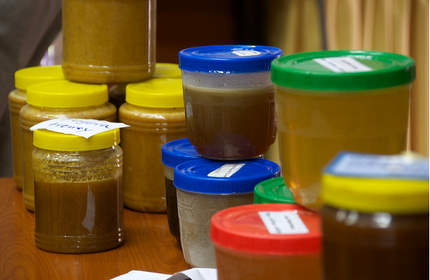
An adhoc market survey for Ethiopian honey


With over 300 people from many different nationalities gathering at the AgKnowledge Share Fair, we took the opportunity to do a quick "taste" market survey for different types of Ethiopian honey.

This would allow producers to see if their honey was marketed at the right value, and if there would be an export market for it.

125 people (35% female - 65% male) tasted the four different types of honey:
  • ATSBI Woreda (priced at 120 birr/kg)
  • BURE Woreda (at 40 birr/kg)
  • FOGERA Woreda (40 birr/kg)
  • GOMA Woreda (40 birr/kg)

The "tasters" preferred:
  • GOMA: 29%
  • ATSBI: 27%
  • BURE: 27%
  • FOGERA: 17%

Preferences were further refined breaking down by gender and nationality, :
Male tasters prefer Atsbi honey as the best followed by Goma, while female tasters prefer Bure honey followed by Goma.

Most Ethiopian tasters preferred Atsbi while most African nationals went for Bure. Foreigners had a sweet tooth for both Goma and Bure.

Picture courtesy Francesco Ciriaci

Social media in Africa - What I learned today

Post by Peter Casier, originally posted on Blog Tips


We are never too old to learn.

This morning, I was participating in a session at the AgKnowledge Africa share fair in Addis, on "How to report on agriculture issues".

One presenter introduced his experiences as a radio reporter, where he travels around interviewing farmers on the diverse aspects of their daily life, their problems and solutions. Rob from Shujaaz explained how they use a combination of comic strips, Facebook, a website and a radio show to reach out to Kenya's youth. Gladston from Story Workshop is using drama and a radio show to get farmers together.

Wednesday, October 20, 2010

Our journey has started: the first day at AgKnowledge ShareFair

Our journey has started: the first day at AgKnowledge ShareFair
The Ethiopian horn blower was at it again at the beginning of the first formal day of proceedings (see report on Day Zero) of the AgKnowledge Africa Share Fair, calling us all to order to get the day underway. Participants were 300 strong for the opening session on the campus of the International Livestock Research Institute (ILRI) in Addis Ababa, Ethiopia.

The session began with a welcome speech by Bruce Scott (ILRI’s Director of Partnerships and Communications), who talked about the importance of small-holder farmers having access to the knowledge necessary to support and boost the agricultural sector in Africa.

Then Lamourdia Thiombian, the representative from the Food and Agriculture Organization of the United Nations (FAO), talked about the importance of gatherings like the Share Fair to facilitate knowledge sharing across all levels. “Knowledge sharing is not only about sharing, it’s about people networking and working together,” he said.

Koda Traore from the Technical Centre for Agricultural and Rural Cooperation (CTA) highlighted the importance of sharing knowledge and allowing it to flow freely, horizontally and vertically.

Then Roxanna Samii (International Fund for Agricultural Developemnt – IFAD) gave us a bit of a history lesson when she talked about the origins of the Share Fair and the impact it has had on many organizations.

Owen Barder, the Director of Aidinfo – a program of Development Initiatives that aims to make information about aid more easily accessible – gave a compelling talk entitled “Is agriculture the key to development?

Read the full post on the ICT-KM blog

You can lead a horse to water….

You can lead a horse to water….
Well in this case it was a donkey… but as the saying goes… “you can lead a horse to water but you cannot make it drink” . Well, let’s think again!

One of the many innovative ways to make knowledge travel at the Africa AgKnowledge ShareFair being hosted at ILRI campus in Addis was to load publications, brochures, gadgets…. whatever organizations traditionally put on display on stands on donkeys and make them  ’traveling around’ the ILRI campus. It was a fun and engaging way to learn what others are doing, share what we are doing, make connections…

Read the full post

Tuesday, October 19, 2010

Day Oh, now I know how to…

Day Oh, now I know how to…

Original posted on the ICT-KM blog

They came from near and far to attend Day Zero of the AgKnowledge Africa Share Fair in Addis Ababa, Ethiopia. And what a day it was too. We were overwhelmed by the response. More than 180 participants attended the various training and sharing sessions held on the campus of the International Livestock Research Institute (ILRI) campus.
“Day Oh, now I know how to… !” (as the training day was dubbed by the ICT-KM Program’s Nadia Manning-Thomas) was called to order by an Ethiopian horn blower. This is just one of the many traditional Ethiopian touches that make this event unique.
During the opening ceremony, Nadia introduced the concepts of knowledge sharing, knowledge management, ICTs, facilitation, social media, online collaboration and networking. She also gave examples on how to identify, choose and implement the right knowledge sharing tools/methods for a particular stage of work and for a particular purpose or goal.

The day was centered around several parallel training sessions (see the agenda), each focusing on different knowledge sharing and communication tools and methodologies.

Read the full post