Showing posts with label sfaddis. Show all posts

Tuesday, November 2, 2010

Drops of conversation verging onto deltas of cooperation?

As I started writing this post, the AgKnowledge ShareFair was about to close and (two or three) hundreds of participants were about to bring back the incredible energy created in those three Fair days back to their work environment. There was an incredible interaction and buzz at the various sessions organised for the Fair and outside – and the question remains: what was more worthwhile: the official programme or the unofficial – social – programme?

At any rate it is a good moment to look back at the end of the pathways, including the water pathway. There as in other pathways, the key question was whether the weaving of conversations started in the share fair would lead to concrete cooperation. In the lingo developed over the last few days in this smaller water channel, the question was thus whether drops of conversation would verge onto deltas of cooperation...

The challenge with water is that it is divided into distinct sub-sectors, and our group of participants represented that diversity: water & sanitation, water for agriculture or water (simply). To join it all up, the red thread – uh, stream – here was to focus on innovation and cooperation/coordination within and among water sectors. And the global pool bar (world café) discussion particularly stressed: lack of incentives, institutional and personal egoism, poor learning and documentation culture, blatant lack of coordination and harmonisation, disconnect between the various actors.

In the second session, the stream talents (1) presented their work and discussed it with other water heads at the Share Fair. Again some interesting issues came out and particularly the Challenge programme for water and food had a useful take about strategies to engage multiple stakeholders (and what’s in it for them?), sustainability issues and an exit strategy. But the micro tube drip irrigation system also triggered a lot of interest

The last session of this stream, finally, was all about cooperation among participants. First off, we scanned potential cooperation among participants? Then we looked at the water towers (information repositories / one-stop shops and other water portals), rivers (discussion groups about water), water carts (newsletters and other special project initiatives) and fountains (water events coming up next). At that stage, the water heads formed a meagre meander and the gravity-led system to raise the water was not strong enough to deliver good water in sufficient quantity and quality.

The final part of this water stream was reflective and showed that focusing on the big picture was not a bad idea. It emphasised the need for the water sectors to form one strong delta. In spite of forming a small stream, water made its way through the Share Fair and is promising to grow stronger. The collection of sonar signals from the water club indicates that there is definitely willingness to tear down the water walls and connect the water towers.

What next? We can’t really tell at this stage but we have a rendez-vous at the end of this year to see how contacts have been followed up. Oh, and though this is a grapevine signal, I heard some people say that AgKnowledge should be followed by another similar event, perhaps more focused on water... WatKnowledge are you talking about? Let’s hope we find out before water’s under the bridge...

The results of discussions and of the session are available on: http://agknowledgeafrica.wikispaces.com/LP-water#res

(1) These talents featured: a) the resource centre network (in Ghana) to organise WASH sector information management and national knowledge sharing across a variety of actors; b) RiPPLE the action-research programme on planning and financing water that leads also to productive activities using the learning and practice alliance (a multi-stakeholder process with platforms at district, regional and national level); c) the Nile Basin Water and Food Challenge Programme (multidisciplinary research framework for the design of transboundary solutions to the Nile Basin’s many challenges) and finally d) the dissemination of the micro-tube drip irrigation developed by the University of Arba Minch.

Wednesday, October 27, 2010

AgKnowledge Africa Share Fair: Les jeux sont faits!

Original posted on the ICT-KM blog

AgKnowledge Africa Share Fair: Les jeux sont faits!
As the AgKnowledge Africa Share Fair concluded at the end of Day Three on the campus of the International livestock Research Institute (ILRI) in Addis Ababa, Ethiopia, I wondered what it was that people would remember the most about this event: what would the over 300 participants take home with them?

“All good things come to an end,” so says Roxanna Samii (International Fund for Agricultural Development – IFAD) in her heartfelt blog post about her last day at the Fair. “The purpose of this Share Fair was to share and learn and I believe that we’ve achieved this goal. I hope that the Fair has left a footprint in the hearts, minds and souls of the participants.”

Roxanna also talks about the radio and telecentre focus groups she attended during the last day. “The radio session was a great example of the impact of the Share Fair,” she says. “The room was packed with participants who before the Share Fair did not know anything about podcasting, podcasting/audio software and hardware. Three days later, here they were showing us the audio files they have created, sharing tips on how to conduct an effective interview and discussing challenges of interviewing with the help of an interpreter and avoiding being lost in translation.

“We closed the radio session with one of the participants saying: ‘YES WE CAN. I now know HOW TO.’ That was such a wonderful way of finishing the session and showed the footprint of the share fair. Often we are asked ‘what has been the impact of events such as share fair?’ The impact of these events is transformative. They change the way people work. They open your mind and remove the cobwebs in your mind, and as a result you inevitably change behaviour, which is transformative.”
Read more about Roxanna’s parting thoughts here.

Making Knowledge Travel

Day Three also saw the ICT-KM Program’s Nadia Manning-Thomas facilitating a “sold-out” session on how to make knowledge travel. She talked about the difficulties associated with getting the right information to the right people at the right time, and the role we can all play in making knowledge travel. She also discussed two initiatives involving the ICT-KM Program that facilitate knowledge sharing: the Triple A Framework, which looks at the availability, accessibility and applicability of research outputs, and the CIARD initiative, which aims to make research results more accessible and usable by stakeholders.

Coming soon: look out for Nadia’s post on this session!

The law of two feet

In his blog post on open space, Andrew Clappison (CommConsult) talks about applying the open space approach to meetings and workshops. One of the main advantages of this face-to-face methodology is that participants can take responsibility for a meeting’s agenda by deciding the topics they want to discuss. However, if an open space sessions goes in a direction that is not to your liking, you are free to apply “The law of two feet” and move onto another session. Of course, if you invoke this law in a meeting that follows a more traditional agenda approach, there might be consequences. Read Andrew’s full post here.

Knowledge Management Impact Assessment session

Day Two Update: This lively session gave knowledge management (KM) practitioners an opportunity to share their experiences and discuss the challenges associated with measuring/assessing the impact of KM initiatives. Open space techniques (Open Popcorn and World Cafe) were used to facilitate the sharing and exchange of experiences and knowledge. The discussion will also provide input to the Knowledge Management Impact Challenge initiative. Despite the great challenge of the KM impact question, the participants dived into lively group debates around 3 questions (accountability, learning and ownership) to think about why it is important for us to be able to explain the changes that result from KM activities, share their experiences of different tools and approaches and work together to think about what we can do better to address this issues. Read the session summary by co-facilitator Louise Clark (Impact Alliance).

During the Share Fair, blog posts, like the ones mentioned above, were generated by our social media team. This group of enthusiastic volunteers headed by Peter Casier comprised participants and facilitators alike, people who took time out of busy schedules to report on the various sessions that took place. I would like to say a big thank you to everyone who helped cover sessions so that others unable to attend could get some insights into how we can all work better together. And if you wonder what social media really is… you may want to read Peter’s post. I am sure you will read more about the lessons learned in organizing such a “controlled anarchy” group.
The Share Fair is now over but you can read the Social Media Team’s coverage on the Share Fair official blog as well as the individual sites of the various tools used:

• Blog: http://tinyurl.com/sfaddisblog
• Wiki: http://tinyurl.com/sfaddiswiki
• Tweets: http://tinyurl.com/sfaddistweets
• Photos: http://tinyurl.com/sfaddisphotos
• Videos: http://tinyurl.com/sfaddisblips
• Social web: http://tinyurl.com/sfaddismention
• Share fair FM: http://tinyurl.com/sfaddisfm

As to myself…. weeks and weeks of preparations and four days of intense interactions have come to an end.. a great team worked to make this possible (special mention to Peter Ballantyne and the ILRI crew who did an amazing job!) we were responsible for organizing the Day 0 (where we delivered more than 350 training ’seats’) and the social media coverage…. and yes… I look back with a great sense of pride… I will write more about that once I come down from “cloud 9″ and catch up with my emails :-)

Reflecting on Agknowledge Africa Knowledge Share Fair #sfaddis

Originally posted on IFAD social reporting blog


I am still all jazzed up and energized by the great Addis Share Fair experience. So, what was so special about this event?

An African event for Africans
Well, for one thing, it was an African event, organized primarily by African for Africans. I do not have the list of participants handy, but I think I am correct to say that 90% of the participants came from Africa! We did a spectogram in the water pathway - where we organized ourselves between North and South pole. It was amazing to see that only 3 people were from the North and the rest came from the South!!

Fully immersed in Ethiopian culture
In true spirit of knowledge sharing, the organizers - the incredible ILRI team - did a remarkable job of weaving in local culture in almost every aspect of the Share Fair. Starting with the wonderful Bunna ladies serving us coffee, to the Ethiopian horn blower - our official time keeper - to creating an Ethiopian market place where participants spent an entire afternoon learning and sharing with each other and last but not least the exquisite Ethiopian food.

Share Fair footprint
Often as KM practitioners we are asked to show the impact of our work. The Addis Share Fair provided numerous opportunities to see the impact and footprint of our collective knowledge management and knowledge sharing efforts.

For example, no matter which session you attended, be it a pathway or a focus group, we saw quite a number of highly engaged and passionate African colleagues facilitating the different sessions using different knowledge sharing methods. We also have a relatively big and vibrant social reporting team. What was wonderful was how participants immediately embraced and put to practice what they learnt on day zero.

We started off with almost no audio coverage. Thanks to Day Zero "I know how day", we ended up having a great podcasting site on Podomatic, a flourishing video section, an equally flourishing blog, many participants contributed to the photo gallery, we had an extraordinary buzz on Twitter.

Inspiring keynote address
Unlike other events that have a rigid and stiff opening session - with lots of rhetoric and formal speeches - the opening session for Addis Share Fair ended up being pretty informal and genuine. All those who took the floor talked about how their respective organizations are engaged with and have embedded knowledge sharing in their core business.

Owen Barder - a charismatic and compelling speaker - delivered an inspiring speech on the importance of knowledge for development. Listening to him talk about importance of concentrating on making knowledge in development more evolutionary and the fact that perhaps we do not really need authoritative answers but rather diversity in answers and as he said "We need diversity, engagement and feedback process", made me realize that if had more people like Owen who can so eloquently offer different perspectives, people who think and conceptualize out of the box, people who bring something new to the table, perhaps we would make huge leaps in achieving both our development and knowledge goals.

Owen is perhaps one of the kind, but at least his refreshing and unconventional talk inspired many of us to the point that we are still talking about it and sharing the gems with colleagues. So who knows, maybe as a result of his talk, we will start a change process within our respective organizations and a year from now, we can claim that this too is a result and footprint of the Agknowledge Africa Share Fair!

Learning pathways and focus groups


In retrospect, the idea of the learning pathways was quite a happenstance. In June, Peter was passing through Rome and our PROCASUR colleague Ariel also happened to be in town. In our conversations with Peter, we suggested that he meet Ariel and pick his brain... and so the idea of "learning pathways" was born from this short but intense brainstorming session.


On the last day of the fair, we heard a short summary of the learning and sharing that happened in the various learning pathways. While all the participants seemed to have enjoyed the experience and learnt from each other, perhaps we could have got more mileage from this new learning and sharing paradigm by providing a space for the pathways to intersect. For example, we could have organized a joint session between the land, water and livestock pathways. This would have allowed participants to exchange and cross fertilize ideas and would have provided the space to get to know more about each others' work, aspirations and challenges - and who knows perhaps we would have achieved different outcomes!

Another innovation in this share fair where the numerous focus groups which provided an opportunity to discuss and share experiences on a wide variety of topics - ranging from reporting on agriculture, to use of mobile telephony, the future of telecentres, process of write shops, how to make sure content travels, challenges and opportunities of working with researchers, and the hot topic of how to engage with young people and what is that we need to do to make living in rural areas enticing!

I think we should definitely replicate the focus groups at future share fairs and if we have hot topics such as youth, we should try and see how to have repeat sessions or even better, how we can have multiple sessions building on each other.

Lessons learnt
Talking of lessons learnt, at the penultimate session of the Share Fair, we finally had the pleasure of hearing the voices of farmers - the very people that we serve. The farmers were indeed the "missing link"  in the Share Fair. Perhaps the biggest lesson learnt for future share fairs is to make sure that we have adequate representation from all the people who we work with and serve - this means smallholder farmers, producers but also decision makers.

When we talk about decision makers, I do not necessarily mean exclusively policy makers - that is ministers of agriculture or finance - but also our organizational decision makers. I believe senior colleagues would have benefited from experiencing the buzz and energy of the Share Fair. They undoubtedly would have learnt from the participants and it goes without saying that they would have had a lot to offer. So perhaps for next time, collectively we should make sure that these events make it to their busy agendas and they take the time to participate in similar events.

As mentioned above, it was really great to see our African colleagues facilitating the various sessions. What we need to do now, is to make a concerted effort to train and build the skills of a new cadre of African facilitators, so that at the next share fair we see new African colleagues taking the lead in training participants and facilitating many more sessions.

Building on this extraordinary experience, we should try and organize more regional events organized by the region for the region and involve much more stakeholders both at grassroots and decision making levels.

What next?
Almost a week after the share fair, I am still living off its energy - and believe me this is really extraordinary! I think I can safely say that as a result of this event, we all managed to expand and extend our networks. We met new colleagues and for sure we'll be calling on each other as and when needed.

So when will be coming back together in another Share Fair? We're all working towards orchestrating a global knowledge share fair late 2011. In the meantime, hopefully there will be more  regional and why not more focused thematic share fairs.

Last but not least, I hope that the #sfaddis blogposts have managed to transmit the spirit of learning and sharing, openness, fun and satisfaction of building colleagues capacity to take on new roles and become agents of change.

Monday, October 25, 2010

It’s all about the people: please meet the CGIAR Ongoing Research Map focal points

This week during the AgKnowledge Africa Share Fair in Addis, a quite secretive group of people was wandering around the ILRI Campus. While at the Fair everything was open to all and people could walk around and participate in learning pathways, focus groups and lively sessions, what was a small group of 10 doing locked up in the Computer Lab?

In true Share Fair spirit, we were doing just a bit more knowledge sharing, only in its software development flavour: user-centred design, a design methodology that aims to incorporate analysis of the needs, constraints and priorities of end users at different stages of the software development process (read a concise overview on Wikipedia).

The focus of our attention was the CGIAR Ongoing Research Map, now in beta and in the process of being extensively redesigned.

The CGIAR Ongoing Research Map has emerged from a prototype based on a mashup of data management technologies, then released as a Beta version last January. Since then, new requirements have been collected through direct feedback from Map users and through Evelyn Katingi, the Map coordinator at the CGIAR Collective Action to whom we owe much for the relentless efforts she spends in weaving relationships, promoting the Map, collecting feedback.

Read the full post on the ICT-KM blog

Chickens and ducks and...

Chickens and ducks and …

Language is a barrier that can have serious implications when it comes to knowledge sharing. This is an issue that has been at the center of many discussions at the AgKnowledge Africa Share Fair hosted by the International Livestock Research Institute (ILRI) in Addis Ababa, Ethiopia.

In her blog post covering the Training and Sharing Day at this event, Camille De Stoop writes about meeting her brother duck – in French. On her ShareFair name tag is a picture of a duck, and during an ice-breaking session she was instructed to find another “duck participant”, which she did: a man from Niger.

Her brother duck was having problems with the language. “Everything is in English,” he said, “the panel discussions, the presentations, and many of the publications.” Another participant from Sénégal was having similar difficulties; while a participant from Kenya pointed out that his mother tongue is Swahili.

Similar problems exit elsewhere. In his blog post “Language still key to effective knowledge sharing”, Andrew Clappison (CommsConsult) wonders what percentage of research for development issues is translated into other languages. His conclusion? Very little.

Read his post to find out what Dr Emmanuel Chabata, from the University of Zimbabwe, had to say in a video interview about his work, which seeks to build capacity in this area and help domesticate knowledge through its translation into local languages.

This is an issue that we discuss also in the third A of our our AAA framework… how applicable is your research if it cannot be read or understood?

Read the full post on the ICT-KM blog

Picture courtesy Shot from the Hip

Friday, October 22, 2010

AgKnowledge Africa Share Fair Round Up: Day Two

Original posted on the ICT-KM blog

AgKnowledge Africa Share Fair Round Up: Day Two
Day Two of the AgKnowledge Africa Share Fair featured a series of nine different focus groups. With topics that covered the documentation of farmer knowledge, mobile devices, value chains, online platforms, reporting agriculture, and more, participants on the campus of the International Livestock Research Institute (ILRI) in Addis Ababa, Ethiopia, were certainly spoiled for choice.

Reporting Agriculture
This lively session showed that agricultural knowledge in Africa can be ‘reported’ through print, radio, television, Facebook, Twitter and other media. Susanna Thorp from WRENmedia talked about the challenges and opportunities of covering agricultural-related issues as well as getting youth involved in agriculture.

“We need to reach out to young people,” she said. “Agriculture is not subsistence only. Agriculture is a source of business.”

Participants discussed the need to make journalists understand the value of reporting about agriculture and how it can be presented in an attractive way.
Susanna concluded the session by saying: “If you want to sell anything – especially if you wish to share and report on agriculture – you need to be passionate!”

If there’s one thing that this Share Fair isn’t short on, it’s passion.

Peter Casier
, the man who is spearheading the social media team at this event, talked about his experience in different countries: conducting video and audio interviews, taking pictures and recording sound snippets. He revealed how he prepared for each interview, processed the video and audio, and then published the results on a wide array of social media channels (blogs, Flickr, YouTube, podcasts, etc). However, he stressed that efforts are all geared to bringing the message OUT. Read his full report here!

Online Platforms

More than 30 participants showed up for the session on online platforms facilitated by Peter Ballantyne, ILRI’s Head of Knowledge Management and Information Services. Different platforms were introduced and their challenges and effectiveness discussed. Participants were told about the importance of making a user-friendly platform and producing content that is accessible, if they are to encourage participation.

Develop a good social media strategy, increase visibility, and partner with other organizations … these were just some of the ideas put forward by the facilitators as a way of increasing engagement with others. They also mentioned the importance of demonstrating effectiveness, adopting ad hoc promotional plans for the different participants and organizing online discussions around the different users.

Pathways

The four pathways convened to build on the previous day’s discussions.

Livestock Pathway

Bridging the gap between researchers and farmer organizations was the theme for the livestock pathways discussion on Day Two. Experts from Kenya, Malawi, Ethiopia, Italy and India presented the innovative tools that they use to create, manage and share knowledge.
Land Pathway

Today’s session
saw participants reflecting on the previous session’s country experiences. Participants talked about addressing the local land issues in the broader context of a sustainable livelihoods plan instead of as a stand-alone issue. Fiona Flintan (ELMT NRM Technical Advisor) presented a paper that provided an overview of the benefits and challenges of customary land tenure systems.

Ariel Halpern of PROCASUR took participants through what is known as the learning route – a tool developed and successfully delivered by PROCASUR to support small farmers, women and youth in about 23 countries. Mino Hardi, who participated in the learning route on Women and Land Rights, now feels suitably motivated to take some ideas from the sussion and pursue them further upon returning to Madagascar.

The Share Fair is now over but you can read the Social Media Team’s coverage on the Share Fair official blog as well as the individual sites of the various tools used:

• Blog: http://tinyurl.com/sfaddisblog

• Wiki: http://tinyurl.com/sfaddiswiki

• Tweets: http://tinyurl.com/sfaddistweets

• Photos: http://tinyurl.com/sfaddisphotos

• Videos: http://tinyurl.com/sfaddisblips

• Social web: http://tinyurl.com/sfaddismention

• Share fair FM: http://tinyurl.com/sfaddisfm

Photo credit: ILRI/Sewunet

Thursday, October 21, 2010

Knowledge should travel in the right direction and faster!

Make Knowledge Travel.

This was the issue discussed by AgKnowledge Africa participants this morning under a fully booked Tent 2.
The session, facilitated by Nadia Manning Thomas (CGIAR), started with a video showing how a natural disaster in Uganda, although forecast by researchers, had caused the death of more than 300 people as no one did anything to prevent it.
It is very common, unfortunately, that the right information does not reach the right people at the right time.

Where does the problem lie?
In the researchers that do not communicate with the farmers for whom scientific publications are inaccessible?
In the communication officers that do not ask for information but, when they do so, are unable to fully master and understand technical documentation?
In the indigenous people whose valuable experience is not shared widely enough?


The discussion that followed the video involved all the participants to the session and a panel of experts working for research, communications and information systems.
As the discussion developed it was clear that we all have a role in making knowledge travel: researchers, communications persons, information systems developers, the policy makers, education systems, extension people, farmers, the private sector and all of us as human beings.

Research: Communication should be incorporated in the researchers’ activities. They should learn how to communicate and share their outcomes in a way which is accessible to those who need to use the information.

Media and Communications Experts: How can the farmers come to them if they if they do not know about their existence? The communication experts should look for the researchers and repackage their information in a format which is accessible to the grassroots level.

Information Systems Developers: They should make sure that technology is functioning and friendly. Technology should facilitate communication not obstruct it.

Policy Makers: Their mandate and also their interest consist of preventing disasters and improving living conditions. But how to effectively link the policy makers with the researchers and the indigenous people?

Indigenous People/Farmers: They could play a key role in knowledge travel thanks to their hands-on experience passed on along the centuries. Researchers need their inputs and support.
Also knowledge sharing among the farmers themselves should be improved, even with some creativity. During the discussion one of the participants mentioned that from the lessons learnt from the farmers, radio scripts could be produced and broadcast for the advantage of other farmers.

All agreed that there is a gap among the actors mentioned above. They all need each other to complete the communication chain but they do not talk enough to each other.
Extension services and advisors are two of the rings that could help hold the chain together facilitating the dialogue among all parties and acting as a central thread.
No doubt farmer schools are also a very valuable tool in the process of knowledge sharing and so is the role of school in children’s education: Children can pass information on to their parents, read out booklets for them, etc.
Online tools such as TECA (Technology for Development) from FAO can make a difference as they present technical information in a simplified form so that extension workers can use it to support the farmers.
It is important to bear in mind that also the private sector plays an important role in this chain; its interests are linked to the market and, consequently, to successful crop production and good land and livestock conditions.

The second part of the video shown at the end of the group discussion highlighted a series of initiatives as a response to lack of information and knowledge sharing.
CGIAR with its Triple A Framework for Availability, Accessibility and Applicability of Research Outputs, and the CIARD initiative aiming to make research results more accessible and usable by stakeholders are two good examples of how development can be enhanced by knowledge sharing, especially when there is coherence among methods used by different groups.

All good things come to an end: Chronicle of last day at Agknowledge Africa Share Fair #sfaddis


I am now sitting at the penultimate session of the Agknowledge Africa Knowledge Share Fair - Focus on Farmers. I am sorry the event is coming to an end. The purpose of this share fair was to share and learn and I believe that we've achieved this goal. I hope that the fair has left a footprint in the hearts, minds and souls of the participants.


Earlier in the day I attended the radio and telecentre focus groups. The radio session was a great example of the impact of the Share Fair. The room was packed with participants who before the share fair did not know anything about podcasting, podcasting/audio software and hardware. Three days later here they were showing us the audio files they have created, sharing tips on how to conduct an effective interview and discuss challenges of interviewing with the help of an interpreter and avoiding being lost in translation.

We closed the radio session with one of the participants saying: "YES WE CAN. I now know HOW TO." That was such a wonderful way of finishing the session and showed the footprint of the share fair.

Often we are asked "what has been the impact of events such as share fair". The impact of these events are transformative. They change the way people work. They open your mind and remove the cobwebs in your mind and as a result you inevitably change behaviour which is transformative.


The telecentre session discussed issues of sustainabililty and how to generate local content. I think we came out of the session agreeing that we should rebapitze telecentres to "Knowledge hubs" or "Service centres".


On issue of sustainability, Paul offered some pragmatic advice on how to create a sustainable service centre, namely make sure:

  • your services are competitive

  • have a number of subsidized services so that you can keep your competitive edge

  • provide a number of free services - especially services that really add value and improve the livelihoods of the smallholder producers, smallholder farmers and rural people
During the session participants mentioned that farmers are willing to pay for information and knowledge which is relevant to them. Personally, I have a problem with that, as we should consider knowledge is public global good and should be made available free of charge. But I stand to be corrected.


The group talked about how in Africa the village experts do not recognize themselves as experts and this is one of the reasons why local knowledge is not documented and shared. We talked about how Africans should exploit and make sure to systematically use their oral culture, their tradition of drama and songs to share local content.

One of the best reflections of this session was the fact that often indigenous knowledge is not valued and challenged by experts/researchers. This made me reflect that it seems to be human nature to underestimate one's own knowledge, perhaps this is why sharing tacit knowledge is a challenge?


We just finished the small group reflection and learning session and have successfully summarized the footprint and impact of this remarkable event in a tweet. Stay tuned and we'll be tweeting them live shortly. Follow #sfaddis

An adhoc market survey for Ethiopian honey


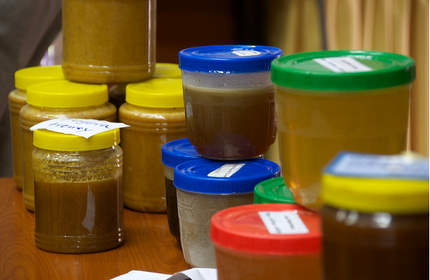
With over 300 people from many different nationalities gathering at the AgKnowledge Share Fair, we took the opportunity to do a quick "taste" market survey for different types of Ethiopian honey.

This would allow producers to see if their honey was marketed at the right value, and if there would be an export market for it.

125 people (35% female - 65% male) tasted the four different types of honey:
  • ATSBI Woreda (priced at 120 birr/kg)
  • BURE Woreda (at 40 birr/kg)
  • FOGERA Woreda (40 birr/kg)
  • GOMA Woreda (40 birr/kg)

The "tasters" preferred:
  • GOMA: 29%
  • ATSBI: 27%
  • BURE: 27%
  • FOGERA: 17%

Preferences were further refined breaking down by gender and nationality, :
Male tasters prefer Atsbi honey as the best followed by Goma, while female tasters prefer Bure honey followed by Goma.

Most Ethiopian tasters preferred Atsbi while most African nationals went for Bure. Foreigners had a sweet tooth for both Goma and Bure.

Picture courtesy Francesco Ciriaci

Social media in Africa - What I learned today

Post by Peter Casier, originally posted on Blog Tips


We are never too old to learn.

This morning, I was participating in a session at the AgKnowledge Africa share fair in Addis, on "How to report on agriculture issues".

One presenter introduced his experiences as a radio reporter, where he travels around interviewing farmers on the diverse aspects of their daily life, their problems and solutions. Rob from Shujaaz explained how they use a combination of comic strips, Facebook, a website and a radio show to reach out to Kenya's youth. Gladston from Story Workshop is using drama and a radio show to get farmers together.

Livestock Learning Pathway: Feedback from the 'Grassroots Group'

By Beth Cullen

On Day One of the Agknowledge Africa sharefair in Addis Ababa I participated in the Livestock Learning Pathway. To start the session we engaged in a mapping exercise in order to acquaint ourselves with one another and to learn more about where people came from. As a result of this mapping exercise we divided into three groups. Each group represented different levels of the livestock sector: policy level, project level and grassroots level. I was part of the Grassroots Group, interestingly the smallest group consisting of only three people: Yared Girma, Felician Ncheye and myself, Beth Cullen. As a group we shared our experiences of livestock related Knowledge Management.

Felician from Tanzania told us about his experiences of sharing best practice of livestock activities at community level. He explained that his work involves packaging and sharing knowledge using a variety of techniques, including CDs, publications, radio broadcasts and experience sharing visits. He has also been involved in organising a committee for livestock, agriculture and fisheries. This committee works to encourage and mobilise peers and to strategise.

Yared from Ethiopia works in the apiculture sector for a Beekeepers Association. The Association currently has approximately 450 members. The Association works to transfer technical knowledge of modern beekeeping techniques in order to build the capacity of its members. They also supply beekeeping equipment. The members process honey and beeswax manually and collect the produce together as an association. This is sold at market places and display centres to nearby communities. The Head office is in Adama (Nazret) in Oromia Region with local offices in various locations.

I shared my experiences of working with Karrayyu Oromo pastoralists in the Awash Valley of Ethiopia using participatory video as a way of conducting participatory and collaborative research. The video was used to direct the research process and was used by community members to document their knowledge, culture and perspectives. Community members focused on pastoralism as a way of life, the importance of animals, the environment and indigenous institutions. The method has a variety of applications for both research and development.

As part of our knowledge sharing we also discussed some of the key issues each of us have been battling with in our work and we visualised the discussion in the form of a map. For Felician the main challenges he has been facing are the identification of markets and securing good prices. Weather can be a problem for livestock keepers, particularly drought periods. There are also insufficient resources, for example lack of funds and equipment. Another problem he identified was the lack of knowledge and information at local level in order to tackle the above mentioned problems adequately. Yared faced some similar difficulties in terms of price fluctuation of honey, beeswax and beekeeping products. He also experiences problems with supply, shortage of finance and access to land for beekeeing, and difficulties packaging products. There are also challenges regarding putting some aspects of the technical knowledge into practice. In my work with the Karrayyu there is a challenge in terms of how to take the PV work further and convey the messages of community members to people at higher level and how to further develop the method for more applied contexts.

After we had discussed in our individual groups we fed back to the other groups and shared experience between the different levels. The discussions and sharing process was very useful in terms of gaining more knowledge of KM activities in different areas of the livestock sector and understanding some of the challenges people are facing in different settings.

Read more about the livestock pathway discussions:

Land pathway getting on their Learning route!

Post by Willem Bettink, originally posted on IFAD social reporting blog


This second day has been very dense with discussion and sharing of experiences that has moved the land pathway onto developing its initial thoughts for the learning route(s). The morning session opened by presenting a first digestion of thoughts based on the country experiences presented yesterday. The experiences with various local land use planning shared the concern of the risk to exclude some particular groups of the local population from access to land in particular pastoralists, and very poor women.

An innovative approach by the SWADE-project in Swaziland enabled the integration of local land use planning into local development planning involving the communities throughout the process. This led Sharefair participants in the land pathway to consider if they should address the local land issues in the broader context of a sustainable livelihoods plan instead of as a stand alone issue.

These reflections fitted well with the presentation of the scoping paper1 prepared by Fiona Flintan, which provides an overview of the benefits and challenges of customary land tenure systems. These include aspects such as: a focus on groups versus individuals; what factors influence the development of the customary system; and what are the challenges for various stakeholders involved.

But how does all of this work in practice-what was learned so far? There needs to be an enabling environment in place; achieving a shared vision and consensus between stakeholders; provision of legal backing for defining roles and responsibilities and a CBO with strong leadership, ownership and capacity.

Halfway though the day the land pathway opened its doors to Ariel Halpern of PROCASUR who completed his Odyssey leaving Chile last Saturday arriving today at the Sharefair at ILRI in Addis. For sure he had not lost his energy to stimulate us with his personal reflections and thoughts. He took us through what is known as the learning route –a tool developed and successfully delivered to support small farmers, women and youth in about 23 countries by PROCASUR.

Learning Routes has proven to be a flexile tool adapting it’s use to a diversity of topics(e.g.local government, land, gender, culture assets, rural business, rural ICTs, rural youth) and a wide range of people and countries specificity. Ariel defined the learning route fundamentals to be:
  • Recognize that in rural areas it is possible to find successful solutions to existing and common problems which can be adapted and multiplied in other context; and

  • Use a learning strategy that enables participants to acquire direct knowledge and arouse their curiosity and interest in learning.
Mino Hardi from Madagascar, who participated in the learning route on Women and Land rights, said that she started the learning route with a lot of ideas about what to do. The powerful experience for her was to visit communities and see how people had achieved putting similar ideas she had into practice –this gave an enormous push to her motivation to pursue her ideas once she returned form this learning route to Madagascar.

At this deep hour into the day, maps of Africa were pulled out! Participants were asked to map out the challenges they face in their countries, what they have to learn and what experiences/practices they can share. Enough for now, but more to follow tomorrow from this committed lot of practitioners!!!


[1] Recognizing, formalizing and supporting customary land tenure in multi-use landscapes- Scoping paper (work in progress) by Fiona Flintan for the International Land Coalition.

Online Platforms: Engage is the motto!


A fully booked Small Auditorium (more than 30 participants) hosted the Wednesday session on Online Platforms facilitated by Peter Ballantyne.
TECA (Technology for Agriculture) and TECA Exchange Group Uganda, the KDID (Knowledge-Driven International Development) Portal from USAID and the FSN Forum (the Global Forum on Food Security and Nutrition) were some of the platforms introduced during the session by their facilitators through punchy 5 minute presentations. These introductions aimed to point out the challenges for online platforms to be effective.


Max Blanck (FSN Forum, FAO) said the FSN Forum’s objective is to achieve larger interconnections worldwide and increase the number of active participants (as opposed to the “passive” participants that follow the discussions without providing contributions).
Of course there is nothing wrong with using a forum without contributing, unless the recipient refrains from doing so by the idea that “all has been already said” and nothing original could be added. What is also preventing from active engagement is reluctance generated by hierarchical barriers and sylos. “Should my contribution be cleared by my organization?”, “What if top management does not agree it?”, “It might be inappropriate for me to contribute if my boss does not”… This mentality deprives online platforms of precious ideas and possible drives for development.


Bruce Kisitu (TECA Uganda Exchange Group Facilitator) explained that the TECA platform is a pilot project to test the sharing of technologies for smallholders in Uganda. He mentioned that one of the main challenges that he has faced is to involve researchers to share technologies because they cannot find an immediate and direct benefit in sharing knowledge. He also added that for the moment, members of the exchange group provide feedback on their experiences in using the platform and lessons learnt are compiled. Lessons from the Uganda pilot will help to set up and facilitate similar exchange and discussion groups in other countries, and to improve the thematic discussions or exchange groups which, like the one on beekeeping, has already been started.


Silvia Sperandini from IFAD raised the issue of how to involve in the discussions people at grassroots level and promote exchange mechanisms within rural communities. She added that other key elements are to keep the interest in the platforms alive and strengthen linkages. Although sometimes linkages become so strong that they abandon the virtual space and become private causing a loss for the community.

USAID mentioned the technical barriers. Make a platform easy to use and produce content which is accessible is fundamental to encourage participation.

How to really engage users, then?
To brainstorm about the issue, Peter divided the participants into groups, each group referring to a different platform's moderator/manager. While the platforms'moderators/managers left the Small Auditorium to discuss among themselves, each group came up with several challenging questions for them. Once they were back in the room, they answered the questions from the group they were assigned to and then shared possible solutions with all the groups together.

Develop a good social media strategy, increase visibility, and partner with other organizations were the ideas put forward by some. Others mentioned the importance of demonstrating effectiveness, of adopting ad hoc promotional plans for the different participants and, as Estibalitz Morras Dimas (TECA Facilitator, FAO) underlined, of organizing the online discussions by themes to allow better targeting of the audience.

Time flew during this fast paced session, discussion could go on and on, and participants seemed unwilling to leave the room at the end of the meeting. Everyone collected good food for thought and concrete suggestions to elaborate more powerful strategies.


Addis Share Fair
ILRI Campus
20 Oct. 2010

Livestock Pathways: Mending the Broken Link

Post by Beatrice Ouma

What kind of information would you gather if you gave a video recorder to a group of Ethiopian women and left them to film their daily lives? Turns out a lot! Bridging the gap between researchers, organizations and farmer organization was the theme for the livestock pathways discussions on Day 2.

Experts from different countries from Kenya, Malawi, Ethiopia, Italy and India presented very innovative tools they are using to create, manage and share knowledge. The session was building on to the previous day discussions that mapped the information sharing landscape in livestock systems.

Participants then formed small groups around the topics they were interested in. One of them was the use of mobile phones to collect data and share information on farm level and market diagnostics as was demonstrated by projects from Kenya and Malawi. Other projects included participatory knowledge sharing through videos and photos, a web-based electronic source of information on selected indigenous farm animal genetic resources (breeds/ecotypes of cattle, sheep, goats, chicken and pigs) in the developing countries. IFAD has a web portal that connects different levels of information creators and users, such portals will lead to better designed projects, better implementation and better impacts.

The livestock sector is witnessing the power technology has! A lot of information is being collected through web based databases, mobile phones, videos and photos. Our job therefore is to make this information accessible, simple and useful to the communities we are working with.
A four finger score! That’s what the participant gave the session, out of a possible five finger score.


Read more about the livestock pathway discussions:

Wednesday, October 20, 2010

Our journey has started: the first day at AgKnowledge ShareFair

Our journey has started: the first day at AgKnowledge ShareFair
The Ethiopian horn blower was at it again at the beginning of the first formal day of proceedings (see report on Day Zero) of the AgKnowledge Africa Share Fair, calling us all to order to get the day underway. Participants were 300 strong for the opening session on the campus of the International Livestock Research Institute (ILRI) in Addis Ababa, Ethiopia.

The session began with a welcome speech by Bruce Scott (ILRI’s Director of Partnerships and Communications), who talked about the importance of small-holder farmers having access to the knowledge necessary to support and boost the agricultural sector in Africa.

Then Lamourdia Thiombian, the representative from the Food and Agriculture Organization of the United Nations (FAO), talked about the importance of gatherings like the Share Fair to facilitate knowledge sharing across all levels. “Knowledge sharing is not only about sharing, it’s about people networking and working together,” he said.

Koda Traore from the Technical Centre for Agricultural and Rural Cooperation (CTA) highlighted the importance of sharing knowledge and allowing it to flow freely, horizontally and vertically.

Then Roxanna Samii (International Fund for Agricultural Developemnt – IFAD) gave us a bit of a history lesson when she talked about the origins of the Share Fair and the impact it has had on many organizations.

Owen Barder, the Director of Aidinfo – a program of Development Initiatives that aims to make information about aid more easily accessible – gave a compelling talk entitled “Is agriculture the key to development?

Read the full post on the ICT-KM blog

You can lead a horse to water….

You can lead a horse to water….
Well in this case it was a donkey… but as the saying goes… “you can lead a horse to water but you cannot make it drink” . Well, let’s think again!

One of the many innovative ways to make knowledge travel at the Africa AgKnowledge ShareFair being hosted at ILRI campus in Addis was to load publications, brochures, gadgets…. whatever organizations traditionally put on display on stands on donkeys and make them  ’traveling around’ the ILRI campus. It was a fun and engaging way to learn what others are doing, share what we are doing, make connections…

Read the full post

Day two of Agknowledge Africa Knowledge Share Fair features focus groups

Posted by Roxanna Samii, originally posted on IFAD social reporting blog


Day two of the Agknowledge Africa Share Fair featured a series of focus groups. Participants had a wide choice and seamlessly distributed themselves among nine different focus groups.

I attended a fascinating session entitled "reporting agriculture" followed by a frustrating session on "mobile devices".

Susanna Thorp from WRENmedia gave a great presentation highlighting the challenges and opportunities of reporting on agricultural related issues. "Agriculture is a multidimensional and multifaceted subject", said Susanna. I was so pleased to hear Susanna refer to smallholder farmers as entrepeneurs. This statement resonates exactly with IFAD's vision!

She then proceeded to touch upon another topic close to IFAD's heart - young people. "We need to reach out to the young people, agriculture is not SUBSISTENCE only. Agriculture is a source of business!", said Susanna.

Not pre-empting the youth session later during the day, we talked how we can keep young people in the farming business. There was a consensus that for this to happen farming has to become a source of income.

The participants recognized that farmers do farming in an integrated manner and they do not just tackle one single aspect. This may be a challenge when one has to report about the topic. At the same time everyone recognized that farmers need to trust their information/knowledge source.

Moving to challenges and opportunities of reporting on agriculture, participants mentioned that one of the challenges we collectively face is to make journalists understand the value of reporting about agriculture. How can we make agriculture an enticing and attractive subject matter?

Rob Burnet shared a wonderful story of convergence of various technologies to communicate effectively. So we start with gold old radio. There was unanimous recognition that radio is an important communication tool for farmers to share information and knowledge.

Rob talked about an FM station run out of Kenya by young people called Shujaaz. What these young people are doing is absolutely remarkable. Besides running the FM station, they are disseminating agriculture related stories via a comic book, which they are distributing through the National Kenyan newspaper and through 12,000 M-PESA kiosks!!!

Moving on from radio, more convergence with social media tools. Shujaaz.fm also has a Facebook account with over 5000 followers, uses Twitter and of course the ubiquitous SMS messaging.

Susanna concluded the session by saying: "If you want to sell anything - especially if you wish to share and report on agriculture you need to be passionate!" And believe me there were many many passionate participants under the tent!!

Later during the day, I attended the mobile session and also virtually participated in the youth session thanks to Gauri's tweet coming out of that session.

I was very frustrated by the mobile session, as I heard more and more about pilot programmes which did not quite make it to the real world. This is really sad. I fail to understand why we need to duplicate and reinvent the wheel when it comes to developing mobile applications. How many market information applications do we need? How many pest control applications do we need.

I came out of that session thinking that there is little or no hope for private-public partnership. I think the only viable way of making any head way is for governments to play a much more prominent role and take things into hand!

In my virtual conversation with Gauri it was nice to see IPSAfrica (@ipsafrica) chipping. I hope they take the suggestion of hosting a virtual converation with young African people to see what is needed for them to stay in rural areas and become the future entrepreneurs!

We finished the morning with a lovely typical Ethiopian lunch. As today was Wednesday, we had a special "fasting lunch", which was based on beans, fish and vegetables!

I've now become an addict to the Bunna, so I proceeded to the Bunna corner and thoroughly enjoyed the wonderful Ethiopian coffee.

Tonight promises to be an exciting night. We'll be having a barbecue and we've been promised good music by the best DJ in town!!!

Sliding along the water stream (pathway)

The pathways have started to turn land over, to move the livestock around and to observe cloud patterns shape up and down. As we initiate our water channel (do you see a pathway in the water?) – we are all aware that water is not a side issue in this event. Water is central to the other pathways, and it involves a very wide variety of interest groups and it is composed of a complex set of sub-sectors. At the heart of the matter, or rather in the eye of the maelstrom, we are therefore interested in how to generate and scale up innovation in such a complex environment and secondly how to we stimulate cooperation and cooperation in the water sectors.

But first, we want to map the diversity of participants and start with a couple of short exercises: grouping ourselves around the room according to the country where we are based. Easy task (even though Ethiopia now seems to stretch from Egypt to Mozambique and Eastwards to India). More difficult now: grouping ourselves according to the water sector we represent – water for food, water and sanitation, water as a global issue... Finally, where do we focus our work on a line from grassroots to global level? Tricky, again: most of us work across the whole chain.

Clearly, the water keyword is integration, but there might still be some specific issues at a given level. We’re diving into it: In 20 minutes, groups of participants (at grassroots, district, national and international level) draw a river at the centre of their sheet and brainstorm about the top 3 issues at that level. Overall, what comes up as issues? The capacity to process and document information, poor access to information, language, inadequate use of technology for knowledge sharing and overall (lack of and need for) harmonisation of our initiatives.

The rest of the session is a global pool bar discussion (World café is sooo 2009) around three issues:
- What are the challenges of generating/scaling up innovation in the water sectors?
- What are the challenges of developing (actually, promoting, stimulating) cooperation and coordination in the water sectors?
- What are the general challenges of developing and sharing knowledge in the water sectors?
The last question is deliberately broad enough with respect to the diversity of participants. And luckily some participants have decided to move beyond the challenges to come to suggested solutions.

The results will be introduced at the start of the second session. What is sure, once again knowledge is flowing among water people and on Wednesday we hope to get to interesting ripples, streams and deltas of cooperation among ourselves.

Are you using your phone at the Share Fair?

Day One at the Share Fair Addis, and its just exciting to see all the various ways that we are using to learn and share knowledge across Africa. I just filmed two colleagues sharing and learning their just acquired skills on using Twitter to share information.


Use of mobile technology will be a major and interesting Focused Group Discussion to follow here at the Share Fair. Focusing on how rural communities can make use of mobile technology to enhance their agricultural and rural development initiatives, it will also showcase some best practices of mobile technology use in rural Uganda and Tanzania.
Government ministries are rarely using social networks to communicate; But i believe, that after this session, Philomena Chege, from Njaa Marufuku Programme at the Ministry of Agriculture, will be able to tweet from her Nokia C3 phone about her experiences here in Addis. She has been very keen on learning how to make videos work in her programme but now she is even more enthused to learn that she can share her information from her phone! With the help of Solomon Mwangi, a Communications Officer at ICRAF, she now has created a twitter account and we expect to see her live tweets contributing to the ShareFair Social media visibility.

These are just some of the side events happening at the #sfaddis

Originally posted on:http://tinyurl.com/2g37tww

New Discoveries at #sfaddis: MENDELEY!!!


Something that most of us here at the Agknowledge Share Fair, Addis, in Addis would not want to discuss, is the process of writing our research papers. But this morning at the Training and Learning Session on Academic social networking using Mendeley, I just realized how easy life can be when I have all my networks and technologies to assist me. Right from setting up a Mendeley account, populating my profile, sharing, creating groups, uploading and privately collaborating on documents, every bit of it was interesting to all of us.

Mendeley is an open source reference manager and academic social network that can help you organize your research, collaborate with others online, and discover the latest research. Interestingly, unlike most social networking tools, Mendeley has a desktop application that you can work on while offline and sync with the web application while online.One more thing that made me actually sign up and create an account, it’s the fact that you can gain cloud access and greater visibility based on your research documents posted on the portal. Since I am just beginner in writing research papers, I believe this will be a good way to create a community of researchers, share my work, collaborate and contribute to the Mendeley statistics of research work. Similar to LinkedIn, I am now populating my profile to include my CV that means it’s much easier for me to reach my potential employers and partners in my work!

Organizations such as IFPRI are already using Mendeley with its entire staff not only for collaborating and sharing their research work, but also to create groups and communities of interest in key issues of interest.

You ask of importing and yes it’s possible, through the Google and Wikipedia tools. Documents can easily be uploaded on the desktop application by simply dragging them from your folders to the application. As well, you can create a watch folder, any time you save a document here; it automatically goes to the Mendely account.

However, there are a few issues to note, just like in any other social networks: intellectual property rights are key in this social network, and be very careful that your citation and referencing is correct. You can only have groups of up to 10 persons; beyond this, you need to pay a fee to Mendeley. You can only access documents on Mendeley if you have an account and friends.

ICT KM and most of the CGIAR centers have been using Mendeley, you need to read more about their experience.

Better get signed up, upload your papers and invite friends to collaborate and share their work as well. That’s why we are at the Share Fair!!!

Originally posted on:http://tinyurl.com/2auyguw