Tuesday, January 20, 2009

The Share Fair opening plenary and keynote

Lots of food for thought in Geoff Parcell's keynote. I'm not a big fan of trying to define knowledge management but I do agree that is it somewhat of an oxymoron. You cannot really manage knowledge but rather, as Geoff quoted from Arian Ward, "managing knowledge is about keeping track of people who know the recipe".

Some points really apply to the experiences of one of the Fair's organizers, who have focused on knowledge capture in the past. For example, when he mentions his BP experience, he says there were no shortage of databases but no one was making use of them. You can't always capture knowledge, but if you do try to capture it, it is only of use if you have networks of people and knowledge sharing to move it around. Just wondering out loud if at times knowledge isn't captured just for the sake of it, for no apparent reason or actual application...

Another relevant point relating to culture change: to change an organization's culture, you need to reinforce the wheel of learning and do it systematically. He mentioned that at BP, over the course of 5 years, culture change did occur. Good leadership behaviours are needed as well, in order to affect change.

Geoff says an event like this Share Fair is really an opportunity to adjust your model of the world, to make sense of things and to come up with a common way of sensing. Here's hoping that in the next few days we can all come away with, if not a common way of sensing, at least increased sense making.

Observations from the Opening Ceremony


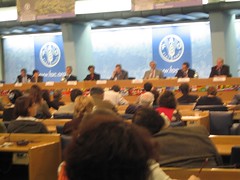
I think a number of us are "social reporting" today - since I'm facilitating or running trainings, this is one of my few opportunities to listen, report and reflect. It is a bit of a cognitive challenge to have an opening ceremony about the vibrant, often messy and very human processes of knowledge sharing being "presented" in the highly formal Plenary room of the FAO. It is an apt metaphor for the challenge we face in trying to weave together living processes with the slower moving structures of large, international organizations. And it is indeed this challenge that I think will be at the core of the next three days. How do we find the mix of processes, tools and underlying values to enable complex, diverse networks to achieve the lofty goals of making sure everyone in the world has safe and sufficient food to eat.

The various organizational representatives are talking about "Why share knowledge -- what are the practical applications" in their organizations. They mention the challenge of large staffs, many of whom are in the field. Diverse national partners in every corner of the world. The representative from WFP (I apologize, but I can't hear well at the back of the room and have not caught all the naems - I'll come back later and fill in names.) is mostly in the field - can you imagine how you keep the knowledge flowing when people are out working on emergency food relief? The complexities of cross sector work. Knowledge sharing is crucial. And complex.

For example, how do we support "bottom up" and horizontal work in traditionally hierarchical organizations. It involves everyone, top, bottom and in between. It requires a culture to sustain and support KS. At Bioversity, there is a planning week to bring distributed staff together and it includes "Speed Dating" - bilateral interactions between every department and group. There is no excuse not to connect with others. It has created energy, buzz and has been very successfull. KS has also been crucial to setting up the organizational research priorities. Finally, engaging with other organizations and networks to connect beyond the organization.

At CGIAR (Consultative Group on International Agricultural Research) - a network of research centers around the world with 8000 staff focused on finding agricultural solutions to real problems. While the CG operates more on the knowledge generation side, they have recognized that knowledge generation alone is incomplete - knowledge needs an application. One of the most important comments Enrica Porcari made was the resistence people have to KS based on "I am too busy." She noted that when we share knowledge, we can actually work better.

IFAD's representative said KS is a requirement, not a "value add" -- essential for applying IFADs knowledge and leveraging the rural partners who deliver development processes. He went on to give some examples in agricultural finance policy and referenced the work being shared in the Fair booths.

Anton Mangstel from FAO talked about the need to provide FAO staff with an enabling environment for staff for networking and knowledge sharing. They started this initiative with a web space and the development of thematic knowledge networks.

As an "outsider" I notice a question that comes up for me - what are the partners and stakeholders of these organizations experiencing? How do we make their voices on KS visible here? One answer is some of the 160 people who are presenting at the Fair. But the challenge is significant. Knowledge sharing is never one way. But organizational power dynamics, the difficulties of distance and fractureded communications infrastructure (i.e Internet access, electricity, cost) will always ask us to do more, to keep trying to think outside of our own organizational realities. Again, looking at the room, with fixed chairs, all facing a podium at the front, we are reminded of the tension between structure and flow, between institutions and networks. We have a large and ongoing challenge/opportunity in front of us!

Monday, January 19, 2009

Adding value with knowledge sharing?

As part of this week's 'sharefair' in Rome, participants are recording short 90 second video responses to the question: "What's the added value of knowledge sharing to your work and your organization?"

FAO's Michael Riggs starts us off:


More video responses

When we prepare... more questions


Today was a day of preparation for many involved with the Share Fair. Those of us leading sessions or trainings tomorrow were briefed and continued to reach out to the amazing 160+ people who are sharing the lessons of their KS work. The steering committee and their staff, friends, colleauges (and I suspect in some cases, families) were wrangled into set up duties, helping organize last minute details and convert FAO's huge atrium into the Fair "central" area.

As some of us gathered to prepare a fishbowl session tomorrow on "What is KM and Why does it matter?" we resurfaced so much of what makes knowledge sharing a slippery proposition. Where does it begin and where does it end. I suggested it is so pervasive - or could be pervasive - that it risks being too big to get one's arms around. And that it is easy to talk about in generalities, or worse, platitudes, but indeed when we strategically and intentionally build paths for KS, it can help us not only get our work done, but done better.

The reason?

We live in a complex, interconnected world. We are overwhelmed with data and information. So we need to use both strong and weak ties with others who share end goals to collectively work towards those goals. There is little we can do by ourselves anymore. So KS becomes the blood that pumps through our work. We rely on KS in very close and structured ways to get the work done in our teams. We rely on looser connections and practices to utilize KS across our overlapping networks. And we rely on both of these to stay informed in a fast changing world, filtered through those relationships and networks. I cover this little bit, you cover that little bit and together, we have a better view of the whole.

This truly asks us to rethink how we work. First of all
  • We can't keep making KS "something else we add to the list." We need to take a hard look at what we should STOP doing, as well as new practices to add.
  • We can't let our outdated institutional systems block KS, particularly old systems that may not have rewarded KS behaviors, strategic plans that have not yet included similar strategic evaluation and inclusion of KS, and the conflict between "taking credit" and the real-world need to work in a networked, cross organizational manner. This is not business as usual.
  • We can work both in formal and informal challenges - this is particularly difficult in organizations which by nature are "political." Networks, one of the most powerful tools at our disposal, don't care about institutional boundaries and if our institutions throw up road blocks, networks simply work around the blocks.
  • We are at a period of workforce shift and we have the opportunity to both embrace the new ways of those born in the digital era, and a deep (and quickly escaping) opportunity to bridge the knowledge of the large cohort of retiring baby boomers. We need both sets of talents. KS can be a key enabler.
I am looking forward to seeing who shows up at the fair, what questions are being asked and conversations are being had. I'm looking forward to seeing how many ideas are liberated from a project or even an institution and flow horizontally across the sector. I'm looking forward to seeing new connections being made.

Opening ceremony is tomorrow - On-site registration will take place at the Main Information Point.

On-Line Registration is closed. On-Site Registration will take place at the Main Information Point.

Opening Ceremony: Tuesday 20 January 2009, 10:00 AM, Plenary Hall (Building A, 3rd Floor).

Share Fair a unique event bringing about change and the gender dimension of KM


In about 27 hours the Share Fair show will start its 3 day journey. The fair's inauguration coincides with President-elect Obama taking oath of office. While history is being made across the Atlantic, in Rome, we too are taking an important step to bring about change by demystifying knowledge management and showing that KM is not a fad but a fact and a way of living.
The preparatory work of this event has been challenging, fun and rewarding. We've learnt a lot, connected with people, established and strengthened our networks. Over the last months I've been reflecting on the "gender dimension of KM". I've been asking myself why is that women are better at knowledge sharing and embracing KM fundamentals. I do not know the answer. I would like to be challenged on this point and if someone out there has done studied the gender dimension of KM I ask them to Share it at the Fair.
Hope to see you all tomorrow and I hope you will enjoy yourselves. Remember the Fair's mantra:
Get out of the Fair your Share of Knowledge

Saturday, January 17, 2009

Reporting from the ShareFair.... a way to include the non-Rome based...

A flurry of activities! It is saturday evening, the end of a warm and sunny in Rome, 2 days to the opening of the ShareFair...e-mails travel fast and furious, the organizers are exchanging drafts, working on last minute logistical issues..."is the programme on-line yet?""Are the signs ready?" "Have the T-shirts arrived?"  ...nothing left to the chance...and in the middle of all of this we could not forget you, you who wanted to participate but for one reason or another could not! Many Rome-based colleagues will hopefully take the opportunity on 20, 21 and 22 January to visit the booths, participate in some of the over 100 sessions, attend the trainings...lots for everybody...but how about those who do not work in Rome? Or are not in Rome now?  Our organizations are highly decentralised, so many many colleagues work in other countries. How can we ensure they could follow and participate? Well, this is when technology lends us a helping hand! Blogging, Twittering, video streaming, podcasting...we will do it all, we will send reports, session summaries, interviews with presenters, photos, videos, blips, podcasts...as sessions take place to report what is happening in the ShareFair. Look at it as our attempt to democratize the Fair, to make sure you stay connected. To do this we have a number of volunteers who will be  your “reporters from the front line”.

So stay tuned and stay connected!